Editorial Note
The longest book on this list and the one most likely to rearrange you. Dostoevsky packs theology, murder, family dysfunction, and the problem of evil into a novel that somehow never feels bloated. The Grand Inquisitor chapter is one of the greatest pieces of prose in any language.
Harris F.
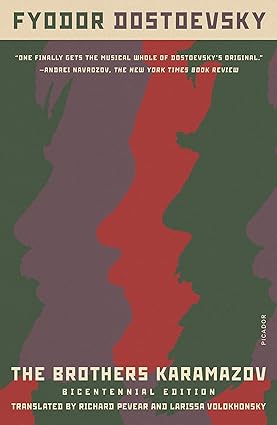
The Brothers Karamazov is Fyodor Dostoevsky’s final novel — completed just four months before his death in 1881 — and it is widely regarded as the summit of his achievement and one of the greatest novels in any language. Sigmund Freud, in his 1928 essay Dostoevsky and Parricide, called it “the most magnificent novel ever written,” and Albert Einstein listed it among the most important books he had ever read. Friedrich Nietzsche, who famously described Dostoevsky as “the only psychologist who had anything to teach me,” drew on the novel’s psychological depth throughout his own late work. The book’s stature rests not merely on its narrative power or its characterisation — extraordinary as both are — but on its capacity to hold, simultaneously and without cheap resolution, the two most serious claims about human existence that the 19th century produced: the case for atheism and the case for faith. No other work in world literature makes the argument against God with such force, and then makes the argument for faith with equal sincerity, within the same covers.
What makes the novel philosophically unique is that Dostoevsky does not stack the deck. The Grand Inquisitor chapter — in which Ivan Karamazov presents what many philosophers and theologians consider the most powerful argument for atheism ever formulated — is not written as a straw man to be knocked down. It is written by a man who felt the force of the argument deeply, and who nonetheless committed the full weight of his craft to exploring whether love, faith, and human community could constitute an answer. The novel’s structure is itself an argument: it places the most devastating intellectual challenge to belief at its centre (Book 5), and surrounds it with the full chaos of human life — passion, murder, legal injustice, childhood suffering, and moments of radical grace — as if to say that the question of God cannot be settled in the abstract but must be lived through to the end. For readers coming to it today, whether as a philosophical text, a work of literary fiction, or a spiritual document, it remains inexhaustible.
The Karamazov Family
The Karamazov family is Dostoevsky’s most deliberately symbolic creation, and each of its members is designed to embody not merely a personality but a philosophical position on the fundamental questions of existence. Fyodor Pavlovich Karamazov, the father, is a debauched landowner of grotesque vitality — selfish, buffoonish, sensual, and entirely without moral scruple. He is the chaotic origin point from which all the novel’s tensions radiate, and his murder, which occurs at the novel’s midpoint, is not merely a crime plot device but a metaphysical event: the killing of the degraded father-figure stands, for Dostoevsky, as a symbol of Russia’s turn away from its spiritual heritage toward the atomised individualism of European modernity.
His three legitimate sons — Dmitri (Mitya), Ivan, and Alyosha — represent three fundamental orientations toward existence, each coherent, each compelling, and each tested by the events of the novel. The fourth son, Smerdyakov, is Fyodor’s illegitimate child by a homeless woman who died in childbirth — contemptible, epileptic, and clever, the dark shadow that the family has tried to pretend does not exist. As a counterpoint to the three brothers, Smerdyakov represents the consequence of ideas without conscience: he is the one who actually commits the murder, and he does so having understood Ivan’s philosophy perfectly. The novel’s secondary characters — Grushenka, the sensual and morally complex woman both Fyodor and Dmitri desire; Katerina Ivanovna, Dmitri’s fiancée who testifies against him in court; and Father Zosima, Alyosha’s spiritual mentor at the monastery — complete a remarkable ensemble in which every character serves both a narrative and a philosophical purpose. Cross-reference the earlier exploration of Dostoevsky’s underground psychology in Notes from Underground, which anticipates the tortured introspection of Ivan’s character.
Book by Book Analysis
The Brothers Karamazov is divided into twelve books, each with its own dramatic focus and philosophical register.
Book 1: History of a Family. The novel opens with a deliberately unheroic backstory: Fyodor Karamazov’s shameful biography, his two marriages, and the scattering of his three legitimate sons to relatives and schools because he is too absorbed in debauchery to raise them. Dostoevsky establishes from the outset that the Karamazov family is not exceptional in its wickedness but representative — these are the contradictions of Russian society in miniature, and the “peculiar family” of the title is also meant as a portrait of a peculiar nation at a historical inflection point. The narrative voice throughout is that of a self-effacing chronicler who claims merely to be recording events he has witnessed, a device that gives the opening sections a deceptive normality before the philosophical turbulence begins.
Book 2: An Unfortunate Gathering. The entire family assembles at the monastery of Elder Zosima to resolve a financial dispute between Fyodor and Dmitri — and the meeting is a disaster of spectacular proportion. Fyodor performs his buffoonery at its most extreme, scandalising the monks and humiliating everyone present; Dmitri arrives late and in a state of passion; and Ivan sits in cold, observational silence. What ought to be a scene of mediation becomes instead a scene of revelation: each character’s fundamental nature is exposed under the pressure of proximity and conflict. Father Zosima’s response to the chaos — he unexpectedly bows down before Dmitri, a gesture whose significance will only become clear later — is the first intimation that the novel’s moral compass will be defined not by the law or reason but by a more mysterious spiritual intelligence.
Book 3: The Sensualists. This book plunges into the operatic passion of Dmitri’s life: his love for Grushenka, his rivalry with his own father for her affections, and the catastrophic state of his finances. Dostoevsky draws Dmitri not as a villain but as a man of tremendous vital force caught in the war between his lower and higher natures — he is capable of both brutality and extraordinary tenderness, sometimes within the same scene. The “Confessions of an Ardent Heart,” in which Dmitri tells Alyosha about his shameful treatment of Katerina Ivanovna and his subsequent helpless love for Grushenka, is one of the novel’s most remarkable passages: a portrait of a man who understands his degradation completely and continues in it anyway, drawn by desire with full open eyes. This is the Karamazov “sensuality” at its most naked — not a simple vice but a form of tragic self-knowledge.
Book 4: Lacerations. Dostoevsky widens the novel’s focus to include a set of secondary characters whose suffering functions as a moral counterweight to the grand philosophical debates among the brothers. The schoolboy Ilyusha Snegiryov, whose dying illness forms the background to Book 10 as well, appears here through his father — a retired military man, Snegiryov senior, who has been publicly humiliated by Dmitri and responds to Alyosha’s charitable overture with a famous and heartbreaking scene of wounded pride refusing mercy. The theme of “laceration” — the way in which humiliation corrupts the soul and prevents reconciliation even when reconciliation is offered — runs through the book’s minor plots and connects to the novel’s larger argument about the social cost of hierarchical cruelty. Dostoevsky insists, through these scenes, that philosophical abstractions about suffering are insufficient unless they engage with the actual suffering of actual people standing in front of you.
Book 5: Pro and Contra. This is the philosophical heart of the entire novel, and one of the most discussed passages in world literature. Ivan presents his “rebellion” against God — not a denial of God’s existence, but a refusal to accept God’s world on the grounds that no harmony, no matter how perfect, can justify the suffering of innocent children. The argument is presented through a collection of newspaper stories about child abuse that Ivan has accumulated, leading to his famous declaration that he “returns the ticket” — he cannot accept a cosmic order purchased at such a price. Then, in the poem of the Grand Inquisitor, Ivan escalates the argument from theodicy to ecclesiology: Christ has returned to 16th-century Seville, and the Church that claims to represent him has decided that his gift of freedom is a catastrophic mistake. The Grand Inquisitor’s speech is a masterpiece of seductive, compassionate totalitarianism, and the fact that its author is a 23-year-old atheist writing in prison is one of the great ironies of literary history. Ivan’s rebellion cannot be dismissed as shallow — Dostoevsky himself described it as the strongest argument against God he could imagine, and he meant it.
Book 6: The Russian Monk. This book is Dostoevsky’s answer to Ivan — or, more precisely, his demonstration that the answer to a philosophical argument is not a counter-argument but a life. Father Zosima’s biography and teachings, as recorded by Alyosha, form a sustained alternative vision of human existence to Ivan’s Grand Inquisitor. Zosima’s theology is centred on what he calls “active love” — not the abstract love of humanity that Ivan claims to feel, but the demanding, specific, present-tense love of actual persons in actual need. His teachings draw on Orthodox Christian mysticism and on a deeply Russian tradition of the starets (spiritual elder) as a figure whose personal sanctity makes wisdom available to others. The formal contrast between Books 5 and 6 is one of Dostoevsky’s greatest structural achievements: the same fundamental question — how do we live in a world of suffering? — is addressed first through brilliant argumentation and then through the texture of a lived and loving life.
Book 7: Alyosha. When Father Zosima dies, his body begins to decompose faster than expected — a biological fact that the monks and townspeople take as a scandalous sign of God’s disfavour, shattering the community’s expectations of a miraculous death. Alyosha, devastated, undergoes a spiritual crisis that Dostoevsky renders with extraordinary psychological precision: the grief of a young person whose faith was not yet tested by disappointment collides with the cruelty of a world that does not perform miracles on schedule. His crisis is resolved through a visionary experience — a dream of the wedding at Cana of Galilee in which Zosima appears to him — and leads to a famous scene in which Alyosha goes outside, throws himself on the earth, and weeps and kisses it, experiencing a moment of radical solidarity with existence. It is one of the most moving scenes in the novel, and it is Dostoevsky’s embodied answer to Ivan’s intellectual rebellion: not an argument, but an act of love toward the actual earth.
Book 8: Mitya. The novel’s plot machinery accelerates dramatically as Dmitri, desperate for money to pay off a debt to Katerina that would free him to leave with Grushenka, undertakes a frantic, farcical, and ultimately tragic night of borrowing, begging, and near-robbery. He arrives at Grushenka’s house to find she has left for a reunion with her first love — a Polish officer — and follows her to the village of Mokroye in a night of champagne, dancing, and desperate joy that has all the qualities of a last supper. The night of his father’s murder — which Dmitri did not commit but which he has the strongest circumstantial motive for — unfolds offstage while Dmitri is at Mokroye, and the irony of his alibi is that it consists entirely of behaviour that makes him look guilty. Dostoevsky constructs the plot so that the innocent man’s conduct is precisely what the guilty man’s would have looked like, and the trap closes with a remorselessness that anticipates Kafka.
Book 9: The Preliminary Investigation. Dmitri’s interrogation by the examining magistrate and the public prosecutor is a tour de force of Dostoevsky’s social observation. The legal machinery is meticulous, rational, and entirely blind to moral truth: the investigators build a coherent, logical case for Dmitri’s guilt out of evidence that Dmitri himself cannot refute because he is concealing a different humiliation — he has stolen money from Katerina weeks earlier, money he has kept as a psychological security blanket and which he cannot return without confessing to a lesser crime. His insistence on his innocence of the murder while simultaneously confessing to every other moral failing in his life produces exactly the impression of a guilty man with a bad conscience. The investigation is Dostoevsky’s sharpest critique of Enlightenment rationalism applied to human affairs: the system of logic and evidence, applied with complete procedural correctness, arrives at a completely unjust conclusion.
Book 10: Boys. This subplot — often considered a separate novella embedded within the larger work — follows Alyosha’s relationship with the schoolboys of the town, particularly the fierce and precocious Kolya Krasotkin and the dying Ilyusha Snegiryov. Kolya is a miniature Ivan — thirteen years old, brilliant, nihilistic, already performing ideas he has absorbed from adult intellectual culture without fully understanding their weight — and his awakening to genuine compassion under Alyosha’s influence is a quiet, hopeful counterplot to Ivan’s breakdown. Ilyusha’s death functions as a micro-version of Ivan’s problem of suffering: a child dies unjustly, surrounded by love that cannot save him, and the response of the community around him — whether to respond with grief, love, and solidarity, or with despair and withdrawal — is Dostoevsky’s image of the moral choice that Ivan’s rebellion poses in miniature.
Book 11: Brother Ivan. Ivan’s psychological deterioration is one of the novel’s most harrowing sequences. His conversations with Smerdyakov, in which he slowly realises that his own philosophy — “if there is no God, everything is permitted” — has been applied by his half-brother to the murder of their father, produce a guilt that is not about what he did but about what he thought: he gave Smerdyakov permission with his ideas, and now the body of his father is the proof. His hallucination of the Devil — a seedy, second-rate figure who arrives in his rooms and engages him in tiresome philosophical conversation — is Dostoevsky’s most daring formal experiment: the Devil speaks in Ivan’s own voice, reflecting his thoughts back at him with a slight distortion, making it impossible to determine whether he is a supernatural entity or a symptom of Ivan’s fracturing sanity. By the time of the trial, Ivan has his confession from Smerdyakov but cannot use it; Smerdyakov has already hanged himself, and Ivan has begun his descent into a mental breakdown.
Book 12: A Judicial Error. The trial of Dmitri Karamazov is simultaneously a thriller, a social satire, and a meditation on the nature of truth and justice. The defence lawyer’s brilliant address — constructing a psychological portrait of Dmitri as a man whose violence was emotional rather than murderous — is undone by Katerina’s surprise testimony, in which she produces a letter Dmitri wrote to her threatening to kill his father. The verdict against Dmitri is wrong, and everyone in the courtroom who knows the truth — Alyosha, Ivan, even the prosecutor — is aware of this in some degree. Dostoevsky’s title for this final book, “A Judicial Error,” is not a spoiler but a statement of theme: the systems by which societies organise truth and justice are instruments of a particular kind of rationality, and that rationality is systematically blind to the moral truth that Dostoevsky’s novel has spent twelve books illuminating.
The Grand Inquisitor
Ivan’s poem of the Grand Inquisitor, embedded within Book 5, has been described by philosophers, theologians, and literary critics as the most powerful piece of philosophical writing in world literature about the problem of freedom. Its premise is deceptively simple: Christ returns to 16th-century Seville during the height of the Inquisition, silently performs miracles for the people, and is immediately arrested by the Grand Inquisitor, a ninety-year-old Cardinal who visits him in his cell that night and delivers a speech explaining why Christ must be burned.
The Inquisitor’s case, laid out with magnificent cold logic, is this: Christ made a catastrophic error when he refused the Devil’s three temptations in the wilderness — bread, miracle, and worldly power. In refusing them, Christ gave humanity freedom, but humanity cannot bear freedom. Most people are too weak, too frightened, and too hungry to exercise genuine moral autonomy. They do not want the burden of choosing between good and evil; they want to be told what to do. The Church has understood this, and so it has corrected Christ’s work: it has taken away freedom and given people miracle, mystery, and authority instead. The people are happy — as sheep are happy — and this happiness is the Church’s gift to them. Christ’s gift of freedom was a form of cruelty.
The Inquisitor’s speech is devastating precisely because it is not wrong about human nature in the way that a strawman argument is wrong. His observations about the human preference for security over freedom, for comforting authority over demanding truth, are confirmed by every chapter of the novel and by every century of subsequent history. Christ’s response — and here is Dostoevsky’s most audacious literary choice — is silence. He listens to the entire speech without a word. At its end, he kisses the old man gently on the lips. The Inquisitor, shaken, releases him, saying: “Go, and come no more.” The kiss — an act of love toward his jailer and accuser — is the novel’s central symbol, and it is not an argument. It is a response to the limits of argument.
Three Brothers, Three Philosophies
The three Karamazov brothers are not merely characters but positions in a philosophical dialogue that Dostoevsky constructs with the care and rigour of a debater who respects all sides.
Dmitri (Mitya), the eldest, represents the carnal and romantic human being — the person who lives entirely in the body and its desires. He is not stupid; he reads Schiller and weeps at beauty. But his intelligence is always in service of his passion, never its master. He knows his degradation and loves it anyway, and this self-awareness-without-self-control is Dostoevsky’s portrait of the Dionysian spirit: creative, vital, terrible, and ultimately helpless before its own nature. Dmitri’s tragedy is not that he is wicked but that he is incomplete — his enormous capacity for love is never properly directed, and the trial that unjustly condemns him may nonetheless, the novel implies, be the instrument of his redemption.
Ivan, the intellectual, represents the rational mind pushed to its logical conclusions — and those conclusions are catastrophic. He is 23 years old, brilliant, and absolutely convinced that reason is the only valid epistemological tool available to human beings. Applied to theology, this conviction produces his rebellion against God; applied to social life, it produces an abstract love of humanity that cannot extend to specific humans. Ivan’s trajectory across the novel is a prolonged dramatisation of what happens when intelligence is divorced from love: he ends in a hallucination, in a courtroom making no sense, in the preliminary stages of a breakdown that the novel leaves unresolved. Dostoevsky does not punish him for his atheism — he presents his collapse as the natural consequence of a certain kind of intellectual pride, the Luciferian error of believing that reason is sufficient.
Alyosha, the youngest, is the novel’s moral centre — and Dostoevsky wisely makes him the hardest character to write about, because his quality is essentially untranslatable into argument. He is not naive; he has understood Ivan’s Grand Inquisitor, and he has no logical refutation of it. He simply continues to act with love, in the present moment, toward the person in front of him. Father Zosima’s teaching — that “active love” is the only authentic response to the world’s suffering, and that abstract love is a form of self-indulgence — is the principle that Alyosha embodies without being able to articulate.
Main Arguments & Insights
The Problem of Evil — Ivan’s Rebellion and Zosima’s Answer. Ivan’s case against God is constructed not on cosmological grounds but on moral ones: he does not deny that God may exist, but he refuses to accept a God whose world includes the torture of innocent children. He presents specific newspaper cases of child abuse with horrifying detail, then asks: what harmony could possibly justify this? Even if a perfect universal harmony exists at the end of history, it will have been built on the tears of children, and he returns his ticket. This is the problem of evil stated in its sharpest possible form — as a moral refusal rather than a logical puzzle. Dostoevsky’s answer, embodied in Father Zosima and Alyosha, is not a theodicy in the philosophical sense: it does not explain why suffering exists. Instead, it insists on a different frame. Zosima’s teaching is that the question “why does suffering exist?” is unanswerable and perhaps wrongly posed; the answerable and morally urgent question is “what do you do now, in the presence of suffering?” Active love in the present moment is the only response available to human beings, and it is, Dostoevsky argues, sufficient — not because it eliminates suffering but because it transforms the meaning of being present to it.
Freedom vs. Security — The Grand Inquisitor’s Seduction. The Inquisitor’s argument that humans prefer miracle, mystery, and authority to the terrifying burden of genuine freedom is the novel’s most dangerous and most seductive idea. It is dangerous because it is compassionate: the Inquisitor genuinely believes that he is serving human happiness, and his contempt for humanity is inseparable from his love for it. He is not a hypocrite but a tragic figure — someone who has understood human weakness so deeply that he has sacrificed his own freedom to manage the weakness of others. The idea is seductive because every social institution — the Church, the State, the market, the algorithm — operates on some version of the Inquisitor’s insight: most people, most of the time, prefer the comfort of certainty to the discomfort of genuine moral autonomy. Dostoevsky presents this as simultaneously the most accurate and the most catastrophic observation one can make about human nature, because accepting it as a basis for action requires treating people as less than they are.
Active Love vs. Abstract Love — Alyosha Against Ivan. One of the novel’s most practically useful distinctions is between genuine love — what Zosima calls “active love,” the demanding, costly, specific attention to the actual person before you — and what might be called abstract or theoretical love, which is Ivan’s form: a love of “humanity” in the aggregate that cannot tolerate actual humans in their particularity, their smell, their neediness, their ingratitude. Ivan says, with characteristic honesty, that he loves people “at a distance” but cannot stand them up close. Alyosha loves people close up, at inconvenient hours, when they are not at their best. The contrast is not a moral condemnation of Ivan — his honesty about his limitations is itself a form of integrity — but a demonstration that love as an abstract principle is insufficient, and that the test of love is always concrete. This distinction anticipates later psychological and philosophical work on the difference between empathy as a felt state and compassion as a practice.
Patricide as Metaphor — The Murder of God. The murder of Fyodor Karamazov is not, for Dostoevsky, simply a plot device: it is a symbolic event with a specific historical meaning. Fyodor is a grotesque parody of the patriarchal order — corrupt, self-serving, deserving of contempt — and his killing represents the Russian intelligentsia’s turn away from the Orthodox faith and its traditional structures toward European rationalism and atheism. Smerdyakov, who carries out the murder, has absorbed Ivan’s ideas without Ivan’s capacity for suffering, which is to say without his conscience. The novel’s implicit argument is that the “killing of the father” — the rejection of inherited moral and spiritual authority — cannot be accomplished without consequence: if there is no God, everything is permitted, and the first thing permitted will be the most primal crime. This is not a conservative argument for the status quo but a warning about the nihilistic potential of ideas that have been separated from the love and suffering that give them weight.
Critical Reception & Perspectives
Freud’s 1928 essay Dostoevsky and Parricide represents the first major systematic engagement with the novel from outside the literary tradition, and its influence on how the 20th century read the Karamazovs has been enormous, though often distorting. Freud reads the novel as a dramatisation of the Oedipus complex: Fyodor is the father who must be killed because he holds both power and the woman (Grushenka), and the brothers’ various responses to his murder represent different mechanisms for managing unconscious parricide-wish and guilt. The reading is brilliant as far as it goes, but it systematically reduces the novel’s philosophical content to psychological symptomatology — Ivan’s Grand Inquisitor becomes a rationalisation of neurosis rather than a genuine philosophical argument, and Alyosha’s faith becomes a sublimated libidinal structure rather than a worked-out moral position. Einstein’s admiration was of a different order: he spoke of the novel in terms of its capacity to illuminate the complexity of human motivation and its refusal to simplify moral reality. The novel’s influence on the development of existentialism — on Camus, Sartre, and Heidegger’s early work — is pervasive and acknowledged, particularly the Grand Inquisitor’s engagement with the problem of radical freedom.
Among literary critics, the question of whether Dostoevsky “answers” Ivan’s Grand Inquisitor has been intensely debated since the novel’s publication. Many critics — including, most famously, D.H. Lawrence — argued that Alyosha’s response is too weak, that a kiss is not a philosophical refutation, and that the novel’s emotional weight falls on the side of Ivan’s rebellion rather than Zosima’s faith. Others, including Mikhail Bakhtin in his landmark study Problems of Dostoevsky’s Poetics, argue that the novel’s polyphonic structure — in which every voice is given its full weight without authorial intervention — is itself the point: Dostoevsky does not answer Ivan because the novel’s form refuses the authority of a single answering voice. The silence that Christ offers the Inquisitor is, on this reading, not a defeat but a formal enactment of the only response available to love when confronted with the full force of reason.
The novel’s modern relevance has, if anything, increased since the 20th century brought the political structure the Grand Inquisitor described into literal existence. The Soviet state — which promised its citizens bread, security, and collective purpose in exchange for freedom — was identified by multiple thinkers, including Nikolai Berdyaev and Alexander Solzhenitsyn, as the Grand Inquisitor’s system made real. The same structural analysis has been applied to the managed consensus of liberal democratic politics, to social media algorithms that give people the content they want to see rather than the truth they need to hear, and to the therapeutic culture’s tendency to prioritise comfort over the discomfort of genuine moral growth. The Grand Inquisitor’s argument is never fully answered because the conditions it describes — human weakness, the temptation of paternalistic authority, the preference for managed happiness over demanding freedom — are permanent features of social life.
Real-World Examples & Implications
-
Albert Camus’ The Stranger and The Rebel — Camus’ philosophical engagement with Ivan’s rebellion is direct and acknowledged. The absurdist hero of The Stranger lives in a world whose silence in the face of suffering is Ivan’s world minus God; The Rebel is essentially a book-length engagement with the question Ivan poses: if one “returns the ticket,” what then? Camus’ answer — revolt without nihilism, rebellion without murder — is a secular response to the challenge the Grand Inquisitor chapter issued to the 20th century.
-
Franz Kafka’s The Trial — The legal nightmare of Dmitri’s trial in Book 12, in which a man is convicted of a crime he did not commit by a process that is procedurally correct and morally blind, was a direct influence on Kafka’s exploration of guilt and judgment. Kafka’s Josef K., like Dmitri, is accused without being told the charge, tried without being able to mount a defence, and convicted without understanding the verdict. Both authors are asking the same question: what does guilt mean in a world where justice is a system rather than a truth?
-
Existentialism — Sartre’s Radical Freedom — Sartre’s concept of radical freedom — the claim that human beings are “condemned to be free,” that there is no given human nature that relieves us of the burden of choice — is a philosophical response to the Grand Inquisitor’s claim that freedom is a burden most people cannot bear. Where the Inquisitor concludes that freedom should therefore be managed, Sartre concludes that it must be confronted. The two positions represent the defining political-philosophical debate of the 20th century, and both of them can be traced to the chapter Ivan Karamazov wrote in 1880.
-
Christian Theology — The Grand Inquisitor’s Challenge — Karl Barth, Dietrich Bonhoeffer, and a succession of 20th-century theologians have cited the Grand Inquisitor chapter as the most serious challenge to Christian faith ever posed in literature. Bonhoeffer, writing from a Nazi prison, engaged directly with the Inquisitor’s argument in Letters and Papers from Prison, arguing for a “religionless Christianity” that takes human moral freedom seriously rather than managing it with religious authority. The chapter has entered the curriculum of seminaries worldwide not as an attack on faith to be refuted, but as the most honest formulation of the challenge that every serious faith must face.
Suggested Further Reading
-
Crime and Punishment by Fyodor Dostoevsky The novel that most directly anticipates The Brothers Karamazov in its exploration of guilt, the psychology of murder, and the relationship between intellectual pride and moral collapse. Raskolnikov’s theory that extraordinary men are permitted to transgress is a first draft of the idea Smerdyakov carries out. View on Goodreads
-
Notes from Underground by Fyodor Dostoevsky Already on this site. The Underground Man is the psychological prototype for Ivan Karamazov: the hyper-intelligent, hyper-conscious individual who cannot act because he can see through every motive and every value. Reading it first illuminates the intellectual genealogy of The Brothers Karamazov’s rational characters. View on Goodreads | Read our summary
-
The Idiot by Fyodor Dostoevsky Prince Myshkin, like Alyosha, is Dostoevsky’s attempt to create a “perfectly good man” in the context of a fallen world. The novel’s failure — Myshkin’s goodness destroys everyone around him — makes it a fascinating counterpoint to The Brothers Karamazov’s more hopeful vision of Alyosha’s faith. View on Goodreads
-
Stoner by John Williams Already on this site. John Williams’ novel about a man who endures professional disappointment, a failed marriage, and social obscurity with quiet dignity is a secular version of the question Dostoevsky asks of Alyosha: can a life of active love and patient suffering be meaningful even when it produces no visible triumph? The formal similarities between the two novels’ emotional register — quiet, devastating, redemptive — are striking. View on Goodreads | Read our summary
-
The Trial by Franz Kafka A direct literary descendant of Book 12’s depiction of a justice system that convicts correctly without understanding truth. Kafka’s novel radicalises Dostoevsky’s critique: in The Trial, not even the defendant has access to the truth of his situation, and the Law operates as pure, illegible power. View on Goodreads
-
The Stranger by Albert Camus Meursault’s complete disconnection from the moral order — his refusal to perform grief, guilt, or social expectation — is Camus’ exploration of what a life looks like after Ivan’s rebellion has been taken to its logical conclusion. Together with The Rebel, it forms the most sustained fictional response to the Grand Inquisitor’s challenge in 20th-century literature. View on Goodreads