Editorial Note
Thiel is a genuinely contrarian thinker, which makes this book both valuable and occasionally maddening. His core argument -- that competition is for losers and monopoly is the goal -- cuts against everything we are taught about markets. Disagree with half of it and still walk away with better questions than you started with.
Harris F.
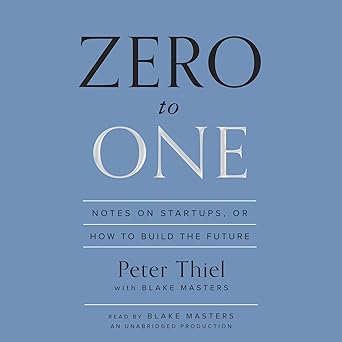
Peter Thiel co-founded PayPal in 1998 alongside Elon Musk, Max Levchin, and Reid Hoffman, and the company’s alumni went on to form one of the most consequential networks in the history of technology. The so-called PayPal Mafia — a loose cohort of founders and early employees who collectively went on to build or fund Tesla, LinkedIn, YouTube, Palantir, SpaceX, Yelp, Yammer, and dozens of other transformative companies — represents a concentration of entrepreneurial success that has no parallel in the modern era. When Thiel speaks about how to build something genuinely new, he does so from an unusual vantage point: he has not only done it himself, but he has watched a remarkable number of his collaborators do it again and again, in radically different domains, using what appear to be shared underlying principles. Zero to One is an attempt to articulate those principles.
The book originated as a set of notes compiled by Stanford student Blake Masters from a class Thiel taught at the university in 2012. The notes circulated widely online — a rarity in an era of short-form distraction — and their viral reach convinced Thiel to expand them into a book. That origin is visible in the text’s structure: each chapter reads like a self-contained lecture, provocative and aphoristic, designed to challenge assumptions rather than build incrementally toward a single thesis. The book’s central contention — that monopolies are better than competition, that the obsession with competitive markets that pervades both economics curricula and startup culture is actively harmful to innovation and value creation — remains genuinely provocative more than a decade after publication. In an era when antitrust regulators in Europe and the United States are working to break up the very companies that embody Thiel’s monopoly thesis, the argument feels simultaneously more validated and more contested than ever.
The Central Distinction: 0 to 1 vs. 1 to N
The animating distinction of the entire book is between two kinds of progress. Horizontal progress — which Thiel calls “1 to N” — means copying things that already work, taking an existing model and replicating it at scale. Globalisation is the paradigm case: taking what works in one country and spreading it to others. It is genuinely valuable, and vast portions of the global economy are devoted to it, but it is essentially imitative. Vertical progress — “0 to 1” — means creating something that has never existed before, doing something that no one has done, going from nothing to something entirely new. Technology, in Thiel’s specific sense of the word, is the mechanism of vertical progress: it is what happens when human ingenuity produces something that changes the fundamental landscape of possibility rather than merely the scale of the familiar.
The distinction matters because 0-to-1 progress is qualitatively different from 1-to-N progress, and the conditions that produce it are correspondingly different. A business that copies an existing model and executes it slightly better is engaged in a fundamentally different activity from a business that creates a new category of product or service. The former requires operational excellence; the latter requires a genuine intellectual breakthrough, combined with the courage to act on a view of the world that most people believe to be wrong. Thiel’s argument is that we systematically underinvest in 0-to-1 thinking — in universities, in venture capital, in corporate R&D — because its payoffs are uncertain and its methods are opaque. The goal of Zero to One is to make those methods slightly less opaque.
Chapter by Chapter Analysis
Zero to One comprises fourteen chapters, each built around a single powerful idea. Together they form a loose manifesto for contrarian thinking in business.
Chapter 1 — The Challenge of the Future: Thiel opens with the observation that the most important question any entrepreneur can ask is: “What important truth do people in your field disagree with you about?” A good answer, he argues, must be something most people believe to be wrong — which means that finding one requires genuine intellectual independence. He introduces the 0-to-1 vs. 1-to-N distinction and argues that the future will be defined by singular, non-replicable innovations rather than by the incremental improvement and global scaling that characterises most contemporary economic activity. The chapter establishes the book’s central intellectual posture: scepticism of conventional wisdom, combined with genuine optimism about the possibility of technological progress.
Chapter 2 — Party Like It’s 1999: A historical analysis of the dot-com bubble and its aftermath that aims to show how the lessons most investors drew from the crash were precisely the wrong ones. The conventional response to the bubble’s collapse — be lean, be flexible, fail fast, iterate — was a rational correction to the irrational exuberance of the late 1990s. But Thiel argues that this correction overshot, producing a generation of entrepreneurs pathologically averse to the bold, definite claims that genuine innovation requires. The real lesson of the 1990s is not that big visions are dangerous but that the market will punish even good ideas if they are funded at insane valuations without a credible path to profitability.
Chapter 3 — All Happy Companies Are Different: This chapter introduces the book’s most provocative economic argument: that the goal of every successful startup should be to achieve a monopoly — to become so good at something that no one can offer a close substitute. Thiel distinguishes between the economist’s concept of monopoly (a single seller in a market, presumed to be extracting rents at the expense of consumers) and his own: a company so differentiated that it has no real competition. He argues that such companies create enormous value, share it generously (because they can afford to), and drive innovation (because they have the profits to invest in it). The title is a deliberate inversion of Tolstoy: all happy families are alike, but in business, all genuinely successful companies are different — each has found a unique way to solve a problem.
Chapter 4 — The Ideology of Competition: One of the book’s most philosophically rich chapters, arguing that the glorification of competition — in schools, in business, in culture — is a form of ideology rather than wisdom. Thiel draws on René Girard’s concept of mimetic desire — the observation that humans tend to want what they see others wanting, and to compete with those closest to them rather than those most distant. In business, this produces the paradox that the most intensely competitive markets are often the least profitable: firms compete fiercely, prices fall to marginal cost, and nobody makes money. Competition destroys value by making companies focus on each other rather than on creating something genuinely new.
Chapter 5 — Last Mover Advantage: The conventional wisdom in startup circles is that being first mover in a market confers a decisive advantage. Thiel argues the opposite: what matters is not being first but being last — building a durable monopoly that will still be dominant years or decades from now. He identifies four characteristics that allow a monopoly to maintain its position: proprietary technology (at least 10x better than competitors), network effects (the product becomes more valuable as more people use it), economies of scale (fixed costs spread over more units), and branding (the perception of uniqueness that resists pure price competition). A startup that achieves all four becomes almost impossible to dislodge.
Chapter 6 — You Are Not a Lottery Ticket: A chapter on the philosophy of the future, distinguishing between definite and indefinite attitudes, and between optimistic and pessimistic ones. Thiel argues that the dominant worldview in modern American business culture is indefinite optimism — a belief that the future will be good combined with an inability to specify how it will be good, which produces investment in diversified portfolios and generic capability-building rather than in specific, ambitious plans. He contrasts this with definite optimism — the attitude of the great American engineers and industrialists of the mid-twentieth century, who built things because they had a specific vision of what the world should look like. He argues that the return of definite optimism is a precondition for significant technological progress.
Chapter 7 — Follow the Money: This chapter is about the power law — the observation that in venture capital, returns are not normally distributed but follow an extreme power law in which a tiny number of investments produce the vast majority of returns, and the rest produce nothing or less. Thiel argues that the implications of this observation are poorly understood, both by venture capitalists (who should concentrate portfolios radically and back only companies that can potentially become transformative monopolies) and by founders (who should understand that only one thing — the single most important thing in the business — will determine success or failure). Every other priority is a distraction.
Chapter 8 — Secrets: One of the most philosophically interesting chapters, arguing that the belief that there are no more great problems to be solved — no more fundamental discoveries to be made, no more genuinely new business models to be built — is false and consequential. The question “What valuable company is nobody building?” depends on the belief that there are still secrets — truths that few people know — that could be the basis for a transformative business. Thiel argues that the most important secrets are about people rather than about nature: facts about what people want and need that are not yet reflected in existing markets or institutions.
Chapter 9 — Foundations: A practical chapter about the early decisions that determine whether a startup will succeed or fail, focused on the importance of choosing co-founders carefully, establishing clear equity ownership and governance from the beginning, and building a founding team whose members genuinely share values and understand each other. Thiel uses the analogy of a marriage: the early decisions — who you partner with, what you agree to, how you handle disagreement — determine the structure within which all future decisions will be made. Mistakes made at founding are disproportionately difficult to correct later, because the legal and cultural structures of a company are far easier to set than to change.
Chapter 10 — The Mechanics of Mafia: This chapter argues that the defining feature of the great startup cultures — PayPal, Apple, Google at their peaks — is an almost cultish intensity of shared belief and purpose. Thiel does not mean this pejoratively: the most effective companies are those in which people believe that they are doing something uniquely important and that their colleagues understand why. This requires careful hiring not for skill or experience alone but for genuine alignment with the company’s specific mission, and it requires a culture that reinforces that alignment continuously. A company where people simply do their jobs and go home is not building a monopoly.
Chapter 11 — If You Build It, Will They Come?: An underappreciated chapter on the critical importance of distribution — the mechanisms by which a product reaches customers — which most engineers instinctively undervalue. Thiel argues that the failure to think systematically about distribution is one of the most common causes of startup failure: a technically superior product that cannot reach customers is worth less than an inferior product with an excellent distribution strategy. He identifies several different distribution models (viral growth, sales, marketing, advertising) and argues that the right choice depends on the product’s price point and the size of the customer’s lifetime value. The chapter is a corrective to the engineering culture’s tendency to assume that quality will market itself.
Chapter 12 — Man and Machine: A reflection on the relationship between artificial intelligence and human labour that is more nuanced than the typical tech industry optimism. Thiel argues that the most promising near-term application of AI is not the replacement of human workers but the complementing of them — using machine intelligence to process information at scales humans cannot and then giving human experts the insight they need to make better decisions. He uses Palantir, his own data analytics company, as an example: its products do not tell analysts what to conclude but give them information they could not otherwise access, leaving the judgment to the human. He argues that the fear of automation displacing human workers misunderstands the relative strengths of machines and people.
Chapter 13 — Seeing Green: An extended case study of the cleantech boom and bust of the early 2000s, used to illustrate the application of the book’s frameworks. Thiel argues that the cleantech companies that failed — the vast majority — failed because they could not answer at least one of the seven critical questions he identifies (engineering, timing, monopoly, people, distribution, durability, secret). They were competing in commodity markets, trying to make incremental improvements to technologies that were already well-understood, with no defensible position and no unique insight. The companies that succeeded — Tesla is the primary example — succeeded because they could answer all seven questions in a way that their competitors could not.
Chapter 14 — The Founder’s Paradox: The concluding chapter, a reflection on the sociology and psychology of entrepreneurial founders. Thiel argues that successful founders tend to be extreme figures in ways that are not accidental: their willingness to hold and act on contrarian views, their capacity for single-minded focus, their comfort with the social isolation that comes from believing something most people think is wrong — these are not incidental personality traits but the psychological preconditions for 0-to-1 thinking. The chapter surveys a range of founder archetypes, from Jobs to Gates to Musk, arguing that the paradox of the founder is that their very extremity — which makes them effective — also makes them vulnerable to the kind of fall that ends many founder stories.
The Monopoly Argument
The intellectual heart of Zero to One is Thiel’s argument that monopoly, not competition, is the engine of genuine value creation. This argument is counterintuitive in a culture saturated with economic orthodoxy, which treats competition as the mechanism that produces efficiency, innovation, and consumer welfare. Thiel’s rebuttal is elegant: competitive markets produce efficient allocation of existing resources but not the creation of new ones. When firms compete fiercely, prices fall to marginal cost, margins evaporate, and no individual firm has the profits to invest in genuinely new products or ideas. The airlines are his canonical example: they carry hundreds of millions of passengers, create enormous economic value, and compete with ferocious intensity — and they make almost nothing. The margin per passenger-mile is so thin that a single bad year can threaten the solvency of an entire carrier.
Google, by contrast, has had a search market share consistently above 90% for most of the past decade. It is, in the strict sense, a monopoly. But Thiel argues that it is precisely Google’s monopoly position that has allowed it to invest in Android, Maps, YouTube, DeepMind, and dozens of other projects that have created enormous value for billions of people. A Google that faced genuine competition in search would not have had the profits to fund those investments. The critical insight is that monopolists and competitive firms describe their market positions in exactly opposite ways: Google, to avoid antitrust scrutiny, emphasises how many different companies and industries it competes with, while airlines, to attract investors, emphasise their differentiated service and brand positions. Both narratives are distortions in the same direction — each firm presents itself as more competitive than it is.
Thiel’s 7 Questions
Distilled from the Seeing Green chapter, Thiel proposes seven questions that every startup must be able to answer satisfactorily in order to have a realistic chance of success. They are not a checklist for incremental improvement but a diagnostic for genuine competitive differentiation — a framework for testing whether a company is doing something truly new or merely doing something familiar slightly better. Thiel argues that most startup failures can be traced to an inability to answer one or more of these questions convincingly, and that the most dangerous situation is not knowing which question you cannot answer.
Main Arguments & Insights
1. Competition Destroys Value: The book’s most subversive argument is that competition — worshipped in economics textbooks and startup culture alike — is often inimical to value creation. Firms locked in intense competition cannot invest in research, cannot attract and retain the best talent, cannot take the long-term risks that genuine innovation requires. The goal should not be to win a competition but to make competition irrelevant — to build something so distinctively valuable that no competitor can credibly offer a substitute. This requires escaping the mimetic trap of watching what competitors do and trying to do it better, in favour of a radical focus on what customers actually need that is not yet being served.
2. Secrets Still Exist: One of the book’s most philosophically interesting contributions is its insistence that the world still contains important truths that most people do not know — secrets that could form the basis of transformative businesses. The belief that all important discoveries have been made, that all profitable business models have been found, is a form of intellectual nihilism that Thiel argues is both false and consequential. The great businesses of the next decade will be built on secrets about human psychology, about what people want that they cannot yet articulate, about physical or biological processes that have not yet been commercially exploited. Finding these secrets requires the willingness to think independently and the courage to act on conclusions that most of your peers believe to be wrong.
3. The Power Law Dominates: Most people think about risk and return in terms of normal distributions — diversify, avoid extremes, seek the middle ground. In the world of startups and venture capital, Thiel argues, this model is dangerously wrong. Outcomes follow a power law: a tiny number of companies produce the vast majority of returns, and the rest produce little or nothing. This has concrete implications for how venture capitalists should construct portfolios (concentrate, not diversify), for how founders should prioritise (identify the one thing that matters most and sacrifice everything else to it), and for how individuals should think about career choices (the best opportunities are almost certainly not the ones that are most obviously safe and conventional).
4. Technology, Not Globalisation, Will Save the World: Thiel’s most ambitious argument is that the problems facing humanity in the twenty-first century — climate change, resource scarcity, pandemic risk, demographic ageing — cannot be solved by spreading existing technologies more widely (1-to-N progress) but require the development of genuinely new ones (0-to-1 progress). Globalisation, for all its benefits in lifting living standards across the developing world, is not sufficient: a world in which eight billion people live at current Western consumption levels is not physically sustainable without technological breakthroughs in energy, materials, and food production. The most important question for humanity’s future is therefore whether we can generate the 0-to-1 innovations we need before the compounding problems of 1-to-N globalisation outrun our capacity to manage them.
Critical Reception & Perspectives
Zero to One was received by the startup and venture capital community with something close to reverence. Entrepreneurs from Marc Andreessen to Elon Musk endorsed it enthusiastically; it quickly became required reading in business schools and tech accelerators and has remained on bestseller lists in its category for nearly a decade. Its admirers praise the clarity of its thinking, the willingness to make genuinely controversial arguments, and the depth of experience that underlies its prescriptions. For practitioners building companies in competitive markets, its framework — particularly the monopoly thesis and the seven questions — provides a genuinely useful diagnostic tool that differs meaningfully from the conventional startup wisdom of lean methodology and agile iteration.
But the book has attracted substantial criticism, much of it focused on its political and ideological dimensions. Critics argue that Thiel’s glorification of monopoly ignores the substantial harms that monopoly power causes to workers, suppliers, and democratic institutions — harms that are not visible in the simplified model of the innovative, benevolent monopolist. The argument that Google’s monopoly enables its investment in public goods looks rather different when set against Google’s use of that monopoly to extract rents from advertisers, suppress competition in adjacent markets, and accumulate data on billions of users without meaningful consent. The same critique applies to Facebook, Amazon, and Apple — companies that fit Thiel’s monopoly template and whose monopoly power has become a matter of serious regulatory concern in both the United States and Europe.
A deeper criticism concerns the book’s relationship to what its detractors call Silicon Valley ideology — a worldview in which the greatest problems are technical rather than political, in which the constraints imposed by democratic governance are obstacles to progress rather than protections of legitimate interests, and in which the entrepreneurs who create the most economic value are the natural leaders of society. Thiel’s political views — he was a major donor to Donald Trump’s 2016 campaign, a vocal critic of democratic governance, and a supporter of various libertarian causes — are not directly present in Zero to One, but they form a context that colours its argument. The claim that the best companies are monopolies that operate above the fray of competition sits uncomfortably alongside a civic tradition that has, for a century and a half, treated the breakup of monopolies as a democratic imperative. Zero to One is a genuinely important book, but it is also a document of a particular historical moment and a particular ideological formation that its readers should understand as such.
Real-World Examples & Implications
-
PayPal’s Network Monopoly: Thiel’s most direct case study is PayPal itself, which survived the dot-com crash by building a genuine network-effects monopoly in digital payments. Once enough buyers and sellers used PayPal, each new user made the network more valuable for all existing users — a dynamic that competitors who lacked critical mass could not replicate. The company’s eventual acquisition by eBay for $1.5 billion in 2002 validated the monopoly model: the price reflected not current revenues but the defensibility of the network position.
-
Palantir and the Human-Machine Frontier: Thiel’s own Palantir Technologies, now a publicly traded company valued in the tens of billions, embodies the man-machine complementarity argument from Chapter 12. Its intelligence analysis platforms do not replace human analysts but give them access to patterns in data that would be invisible without machine processing. The company’s contracts with intelligence agencies, law enforcement, and financial institutions reflect a bet that the most valuable near-term application of data science is augmenting human judgment, not replacing it.
-
SpaceX and Definite Optimism: Elon Musk’s SpaceX exemplifies Thiel’s concept of definite optimism — a company built on a specific, extremely ambitious vision (making humanity multi-planetary) using technology (reusable rockets) that most aerospace engineers believed to be impractical. By committing to a definite goal and building backward from it, SpaceX achieved cost reductions in launch that the incremental, indefinitely optimistic approach of legacy aerospace contractors could not match. It is now the most capable launch provider in the world.
-
AI Companies Building Tomorrow’s Monopolies: The current wave of AI investment mirrors the dynamics Thiel describes. Companies like OpenAI, Anthropic, and DeepMind are racing to achieve the kind of technological lead — 10x better than anything else — that would translate into a durable monopoly position in foundation models. The network effects of AI are potentially enormous: more users produce more data, which trains better models, which attract more users. Whether these dynamics will produce the kind of benevolent monopoly Thiel envisions, or a more problematic concentration of power in a small number of companies, is one of the defining questions of the current technological moment.
Suggested Further Reading
-
The Innovator’s Dilemma - Clayton Christensen : Christensen’s landmark account of why successful, well-managed companies consistently fail to adopt disruptive innovations provides an essential complement to Thiel’s monopoly thesis. Where Thiel focuses on how to build a dominant market position, Christensen explains why incumbents - even excellent ones - are structurally prevented from defending it against genuinely new challengers. Together, the two books provide a complete map of the innovation landscape from both the attacker’s and the defender’s perspective. View on Goodreads
-
Poor Charlie’s Almanack - Charlie Munger : Already featured on this site, Munger’s collection of speeches and frameworks shares Thiel’s commitment to genuinely independent thinking and his scepticism of conventional wisdom. Munger’s concept of the “mental models lattice” - building a toolkit of frameworks from multiple disciplines to think more clearly about complex problems - is a practical complement to Thiel’s more polemical prescriptions. View on Goodreads | Read our summary
-
The Hard Thing About Hard Things - Ben Horowitz : Where Zero to One is primarily philosophical, Horowitz’s memoir-cum-management-manual deals with the brutal operational reality of running a startup in difficulty - layoffs, cash crises, leadership failures, the psychological cost of the founder role. Horowitz, who co-founded Andreessen Horowitz after selling his company Opsware to HP for $1.6 billion, writes with a directness and specificity that Thiel’s more theoretical work lacks. The two books are ideal complements. View on Goodreads
-
High Output Management - Andy Grove : Intel’s legendary CEO Andy Grove wrote the definitive operational management manual for technology companies, focused on how to organise people and processes to maximise output from teams building complex products. Grove’s framework of one-on-ones, OKRs, and leverage-based management has shaped the operational culture of most major Silicon Valley companies and remains the most rigorous treatment of the mechanics of managing technical organisations at scale. View on Goodreads
-
The Lean Startup - Eric Ries : Ries’s manifesto for iterative, data-driven product development represents in many ways the philosophical opposite of Thiel’s definite optimism - and reading both together is illuminating. Ries argues for minimising commitment to any single vision, validating assumptions continuously, and pivoting rapidly on the basis of data. Thiel argues that this approach produces incremental improvements rather than breakthroughs. Both are right about something important, and the tension between them is one of the most productive in contemporary entrepreneurship thinking. View on Goodreads
-
Blitzscaling - Reid Hoffman : Hoffman, who co-founded LinkedIn and was a central figure in the PayPal Mafia, extends Thiel’s monopoly thesis into a framework for the specific challenge of scaling a startup faster than competitors can respond. His concept of “blitzscaling” - prioritising speed over efficiency, accepting short-term chaos in pursuit of a defensible market position - is in many ways the operational expression of Thiel’s strategic argument: once you have found a 0-to-1 insight, the imperative is to scale it to monopoly before anyone else can. View on Goodreads