Editorial Note
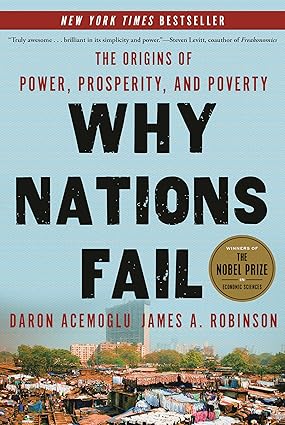
The thesis is deceptively simple: nations fail because of extractive institutions, not geography or culture. Acemoglu and Robinson spend 500 pages making it very hard to argue with. A necessary counterpoint to Diamond's Guns, Germs, and Steel -- read them back to back.
Harris F.
The question of why some nations are rich and others poor is the oldest and most consequential puzzle in economics. Adam Smith devoted The Wealth of Nations to it in 1776. Malthus agonised over it. Marx built an entire philosophical system around his answer. In the twentieth century, the debate sharpened as the gap between rich and poor countries widened to historically unprecedented levels, producing competing schools: Jeffrey Sachs argued that geography and disease burdens trap nations in poverty, and that targeted aid could break the cycle. Jared Diamond, in Guns, Germs, and Steel — already summarised on this site — argued that geographic luck determined which civilisations developed the technologies and pathogens that enabled conquest and complexity. Max Weber pointed to culture, specifically the Protestant work ethic, as the engine of Northern European prosperity. Each of these theories carries genuine explanatory force for some cases. None of them, Daron Acemoglu and James Robinson argue, is sufficient — and none of them can explain the cases that matter most.
Why Nations Fail, published in 2012, represents the culmination of fifteen years of comparative research across five continents by two of the world’s most accomplished political economists. Acemoglu, an MIT economist, and Robinson, a Harvard political scientist, drew on economic history, political theory, game theory, and fieldwork from Colombia to the Congo, from Sierra Leone to South Korea, to construct a single unified framework. Their core claim is both startlingly simple and deeply unsettling: the wealth or poverty of nations is determined primarily by their political and economic institutions — specifically, whether those institutions are inclusive or extractive. Geography shapes the constraints within which institutions form, but it does not determine them. Culture influences behaviour but is itself shaped by institutions. The ignorance hypothesis — the idea that poor countries are simply led by well-meaning rulers who don’t yet know the right policies — fails because extractive elites know exactly what they are doing. They are poor not because their leaders are ignorant, but because their leaders are rational.
The Core Theory: Institutions
The book’s central distinction is between inclusive institutions and extractive institutions. Inclusive economic institutions are those that secure private property rights, enforce contracts, provide access to capital and education, and allow markets to function competitively — including allowing creative destruction, the process by which new technologies and business models displace old ones. Inclusive political institutions are those that distribute political power broadly, enforce the rule of law against elites as well as commoners, maintain pluralism, and create checks and balances that prevent any single group from seizing unchecked control. Crucially, the two reinforce each other: inclusive economic institutions tend to emerge from inclusive political institutions, and the broad prosperity they generate tends to sustain pluralistic politics.
Extractive institutions work in the opposite direction. Extractive economic institutions are designed to extract income and wealth from the many for the benefit of the few — through monopoly, forced labour, denial of property rights, barriers to entry, and suppression of competition. Extractive political institutions concentrate power in the hands of an elite that uses it to maintain and expand economic extraction. The critical insight — and this is what distinguishes Acemoglu and Robinson’s framework from earlier work — is that extractive elites actively block creative destruction and institutional change not from ignorance but from rational self-interest. A new technology or business model that would enrich the nation might also destabilise the political order that keeps the elite in power. The Ottoman Empire’s resistance to the printing press, the Austro-Hungarian Empire’s suppression of railways, the Soviet Union’s stifling of entrepreneurship — these were not accidents or oversights; they were the rational responses of extractive elites to technologies that threatened their grip on power.
Chapter by Chapter Analysis
So Close and Yet So Different — Nogales, Arizona vs. Nogales, Sonora: The book opens with one of the most elegant natural experiments in social science: the city of Nogales, divided by the US–Mexico border. Both sides share the same geography, the same climate, the same culture, the same history prior to the border’s establishment, and largely the same population gene pool. Yet the American side is substantially richer, healthier, better educated, and safer than the Mexican side. The difference cannot be geography, culture, or biology — it must be institutions. This single example does more to undermine the standard geographic and cultural explanations than pages of regression analysis, and Acemoglu and Robinson deploy it with rhetorical precision as the book’s opening salvo.
Theories That Don’t Work: With careful analytical rigour, the authors dismantle the three dominant alternative explanations for global inequality. The geography hypothesis (Sachs) fails because pairs of similarly situated nations differ dramatically when their institutions differ — Botswana vs. Zimbabwe, North vs. South Korea. The culture hypothesis (Weber, Huntington) fails because cultures are themselves shaped by institutions: the work ethic and trust that characterise prosperous nations are more consequence than cause of inclusive institutions. The ignorance hypothesis — that poor-country leaders simply don’t know the right policies — is the most intellectually comfortable of the three, but also the most naive: extractive elites are not confused; they are protecting a system that benefits them personally, at enormous cost to everyone else.
The Making of Prosperity and Poverty: This chapter excavates the historical roots of institutional divergence, tracing how the same colonial experiences played out differently depending on pre-existing conditions and the choices made by colonisers. Where Europeans settled in large numbers and couldn’t easily exploit the indigenous population — as in North America or Australia — they built inclusive institutions, because they needed the cooperation of settlers and had to govern themselves. Where Europeans arrived in small numbers to extract resources from large indigenous or enslaved populations — as in much of Latin America, Africa, and the Caribbean — they built extractive institutions that proved extraordinarily durable, outlasting independence and persisting into the present. Prosperity and poverty, in this account, are not random or natural; they are the accumulated consequences of centuries of institutional choices.
Small Differences and Critical Junctures: One of the book’s most important theoretical contributions is its account of path dependence — the mechanism by which small, contingent differences in institutional quality get amplified over time into vast wealth gaps. A slightly more pluralistic political system in seventeenth-century England, compared to Spain, put England in a position to respond differently to the Atlantic trade and the Industrial Revolution, compounding its advantages over generations. Critical junctures — moments of economic or political disruption that could tip institutions in either direction — are the hinge points of history. Whether a society emerges from a critical juncture with more or less inclusive institutions depends on the balance of political forces at that particular moment, which is itself partly a product of prior institutional history. The result is a world in which history is neither random nor inevitable, but deeply contingent.
I’ve Seen the Future and It Works — Soviet Growth: The chapter title quotes a journalist’s breathless endorsement of the Soviet Union in the 1930s, and it sets up a crucial test for the theory. The Soviet Union grew impressively from the 1920s through the 1960s — at rates that alarmed Western economists and led many to predict that it would overtake the capitalist world. Acemoglu and Robinson explain this growth as the product of resource reallocation — moving labour from agriculture to industry, rapidly deploying existing technologies, mobilising capital through state coercion — and argue that it was inherently unsustainable. Without inclusive economic institutions, the Soviet system could not generate innovation: it could adopt technologies but not create them, mobilise factors of production but not recombine them creatively. By the 1970s, growth had stalled and the system was visibly decaying, confirming that extractive institutions can produce impressive growth in the short run but cannot sustain it indefinitely.
Drifting Apart — Colonial Divergence: The authors trace how European colonialism did not simply exploit existing inequalities but actively created new ones, embedding extractive institutions in societies that might otherwise have developed differently. The crucial variable was the nature of the colonial project: settler colonialism tended to create inclusive institutions because settlers demanded rights and protections for themselves; extractive colonialism — plantations, mines, forced labour — created institutions designed to funnel wealth upward, which persisted long after the colonisers left. The post-independence leaders of Congo, Zimbabwe, and Haiti inherited institutional frameworks designed for extraction, not development, and often continued operating them in the same fashion, directing the extraction toward themselves rather than a distant metropole.
The Turning Point — The Glorious Revolution of 1688: The English Glorious Revolution — in which Parliament asserted supremacy over the Crown, secured property rights, extended economic freedom, and established the foundations of an independent judiciary — is the book’s central historical pivot. Acemoglu and Robinson argue that this event, which might appear to be a minor constitutional adjustment, was in fact the institutional critical juncture that made England’s Industrial Revolution possible. By securing property rights and limiting arbitrary royal power, it created the conditions under which entrepreneurs could invest, inventors could profit from their inventions, and financial markets could develop to allocate capital to productive uses. The Industrial Revolution was not a technological accident; it was an institutional achievement, made possible by the political settlement of 1688.
Not on Our Turf — Elites Block Change: This chapter explores the mechanism by which extractive elites resist institutional change, even when change would be economically beneficial in aggregate. The key insight is that inclusive institutions threaten not just the economic rents of extractive elites but also their political power — and it is political power that protects all the other privileges. The Ottoman Empire blocked the printing press for two centuries, recognising that mass literacy would threaten clerical and state authority. The Russian Tsars blocked railways in some regions, fearing that faster movement of people and ideas would destabilise social control. In the Congo, King Leopold’s personal extractive apparatus was so efficient at preventing any form of local institution-building that the country was left with essentially no functioning public institutions at independence — a catastrophe from which it has never recovered.
Reversing Development — Colonialism as Destruction: One of the book’s most important and disturbing chapters, this examines cases where colonialism did not merely fail to develop inclusive institutions but actively destroyed functioning ones that already existed. The pre-colonial kingdoms of West and Central Africa had developed complex trade networks, legal systems, and governance structures; European colonialism systematically dismantled these, replacing them with extraction-oriented apparatuses that served colonial purposes but left nothing of value behind. This insight challenges the more charitable readings of colonialism’s legacy, which credit it with introducing property rights and rule of law: in many cases, it did the opposite, replacing functioning indigenous institutions with purely extractive ones designed to funnel wealth to Europe.
The Diffusion of Prosperity: Why did inclusive institutions spread from England to the United States, Western Europe, and eventually much of the world? And why did they fail to spread elsewhere? This chapter traces the mechanisms of institutional diffusion: colonial settlement, trade networks, political pressure, and sometimes deliberate institutional design by post-independence founders. The American founding fathers, who had lived under extractive British colonial policies, deliberately designed institutions to prevent elite capture — the separation of powers, federalism, the Bill of Rights, the right to bear arms as a check on tyranny. These choices were not random; they were the product of people who understood, from experience, what extractive institutions felt like.
The Virtuous Circle — Self-Reinforcing Inclusion: Once established, inclusive institutions create powerful positive feedback loops. Broad economic participation generates a large middle class with interests in sustaining the rule of law. Pluralistic politics prevents any single group from seizing enough power to roll back inclusive economics. The press, civil society, and independent judiciary provide ongoing checks on elite capture. These mechanisms explain why inclusive institutions, once established, tend to persist: the constituencies that benefit from them are too numerous and too politically powerful to be overridden. England after 1688, the United States after the Constitution, Botswana after independence — all show how inclusive institutions, once in place, tend to deepen and expand rather than contract.
The Vicious Circle — Self-Perpetuating Extraction: The mirror image of the virtuous circle: extractive institutions generate concentrated wealth and power that elite groups use to perpetuate extraction. The wealthy fund political parties and militias, capture regulatory agencies, and shape legal systems in their favour. In extreme cases — the Congo, Zimbabwe, Haiti — extraction becomes so total that it destroys the economic base that makes extraction possible, producing a downward spiral of state failure. The authors note that the vicious circle is not merely about rich vs. poor within a society: it is about the institutional structure that determines whether wealth and power are dispersed or concentrated, and that structure tends powerfully to reproduce itself.
Why Nations Fail Today: Drawing on contemporary case studies — Zimbabwe under Mugabe, North Korea under the Kims, Sierra Leone, Colombia, Egypt — this chapter demonstrates that the inclusive/extractive framework applies not just to historical cases but to the ongoing divergence of contemporary nations. Mugabe’s Zimbabwe is a case study in deliberate institutional destruction: starting from a moderately functioning economy, Mugabe systematically dismantled property rights, destroyed judicial independence, and used political power to enrich his cronies, producing hyperinflation and economic collapse within a generation. The lesson is both sobering and clarifying: the failure of today’s poor nations is not a mystery requiring exotic explanations; it is the predictable consequence of identifiable institutional pathologies.
Breaking the Mold — Rare Institutional Change: The book’s most honest chapter, which confronts the hardest question: if extractive institutions self-perpetuate through the vicious circle, how does change ever happen? The authors identify several mechanisms — external shocks that shatter existing coalitions, broad-based social movements that overcome collective action problems, elite factions that defect from the extractive coalition when they calculate that inclusive institutions will serve them better. The Glorious Revolution was partly driven by commercial elites who concluded that limiting royal arbitrary power would benefit them economically. Botswana’s success story — an African country that emerged from colonialism with functional institutions and has maintained them — reflects partly luck, partly the leadership of Seretse Khama, and partly the constraints imposed by a cattle-herding economy that created broad property-owning interests. Change is rare, contingent, and fragile — but it is possible.
The Virtuous and Vicious Cycles
The most powerful structural insight in Why Nations Fail is the concept of institutional feedback loops. Once a society establishes inclusive political institutions — pluralistic power, rule of law, checks and balances — those institutions create the conditions for inclusive economic institutions: secure property rights, access to markets, competitive labour markets. Inclusive economic institutions generate broad prosperity, which creates a large, politically engaged middle class with strong interests in sustaining the rule of law and limiting elite power. This broad political coalition sustains and deepens inclusive political institutions, completing the virtuous circle. The result is a self-reinforcing dynamic that explains why successful societies tend to stay successful: it is not merely wealth that sustains them, but the institutional architecture that generates and distributes wealth broadly enough to create robust constituencies for its continuation.
The vicious circle operates with equal and opposite force. Extractive political institutions — concentrated power, weak rule of law, no checks on elite authority — generate extractive economic institutions: monopoly, forced labour, barriers to entry, arbitrary expropriation. These institutions concentrate wealth in the hands of the politically connected elite, which uses its wealth to fund the political mechanisms — patronage, coercion, propaganda — that perpetuate its political dominance. There is no natural corrective mechanism: the vicious circle is broken only by external shocks or internal political crises that disrupt the elite coalition, and even then, the new power-holders frequently replicate the extractive structures they inherited, because those structures are simultaneously a template for governance and a tool for enrichment. This explains what might otherwise appear to be a paradox: why political revolutions so frequently leave the economic system untouched.
Critical Junctures
History does not move in straight lines. It accumulates slowly along established paths — institutions reproducing themselves, power structures maintaining their equilibria — and then pivots sharply at moments of disruption that Acemoglu and Robinson call critical junctures. The Black Death of the fourteenth century killed a third of Europe’s population and shattered the labour relations that had sustained feudalism. In Western Europe, where serfdom was already weakening and peasants had more leverage, the resulting labour scarcity empowered surviving workers to demand better conditions and escape manorial bondage — a process that over generations built the more pluralistic institutions that would underpin the Renaissance, the Reformation, and the eventual emergence of property rights. In Eastern Europe, where lords had more political power and peasants less leverage, the same demographic shock produced the opposite result: landowners responded to labour scarcity by tightening serfdom, binding peasants more firmly to the land. The same event, processed through different existing institutional structures, produced century-spanning divergence.
The Atlantic trade of the sixteenth century enriched merchant classes in England and the Netherlands, who used their new wealth to challenge royal authority and push for the property rights and market freedoms that would eventually produce the Glorious Revolution and the Dutch Republic. In Spain, the same trade flows enriched the Crown rather than a mercantile class — because Spanish institutions concentrated commercial profits in royal hands — which allowed the Spanish monarchy to sidestep the political negotiations that forced English and Dutch kings to grant concessions to merchants and parliaments. England’s Industrial Revolution was therefore not a lucky accident; it was the downstream consequence of a critical juncture in which Atlantic trade happened to strengthen the political hand of pluralistic commercial interests rather than an absolutist monarchy. The Industrial Revolution itself was another critical juncture: nations with inclusive institutions could adopt and adapt the new technologies through competitive markets and private investment; extractive regimes blocked industrial development because the disruption threatened established power structures, falling behind in ways that compounded across generations.
Main Arguments & Insights
1. The Nogales Challenge to the Geography Thesis: The twin cities of Nogales — one in Arizona, one in Sonora — constitute the book’s sharpest empirical challenge to geographic determinism. Both sides of the border share identical latitude, identical climate, identical topography, and a population drawn from the same ancestral pool. The American side has per-capita incomes several times higher than the Mexican side, better health outcomes, better-funded schools, and vastly lower rates of violent crime. Jeffrey Sachs and other proponents of geographic determinism have no good answer for Nogales, because geography is identical on both sides of the fence. The only thing that differs is the institutional environment — the legal systems, property rights, and political structures that govern economic life on either side of the border. The authors note, with some relish, that the border itself is the most concentrated possible demonstration that institutions, not nature, determine outcomes.
2. The Korean Peninsula and the Culture Hypothesis: North and South Korea shared a common language, a common culture, a common history, and the same agricultural and industrial base at the moment of partition in 1945. Within two generations, they have become almost incomprehensibly different: South Korea is one of the world’s great economic success stories, a high-income democracy with world-class technology companies and universities; North Korea is one of the world’s most extreme examples of state failure, a country where periodic famines kill hundreds of thousands and the average person is inches shorter than their Southern counterpart due to childhood malnutrition. Culture cannot explain this divergence — the cultures were identical at the starting point. The only variable that differs is the institutional structure imposed after partition: inclusive in the South, extractive to a pathological degree in the North.
3. Contingency and Path Dependence: One of the book’s most philosophically important claims is that history is neither random nor deterministic, but contingent: small differences in institutional quality, political coalitions, and historical circumstance get amplified by positive feedback loops into large, durable wealth gaps. The Glorious Revolution was not inevitable — it was the product of a specific political crisis in which a specific coalition of aristocrats, merchants, and dissenting Protestants happened to have enough leverage to impose constitutional constraints on the Crown. Had James II been slightly more politically adept, or had the Dutch invasion failed, English history might have followed a different path. But because it happened — and because it happened when it did, at the beginning of the age of Atlantic commerce — it set England on an institutional trajectory that compounded for three centuries. This is a profoundly anti-determinist account of history: it insists that contingency is real, that things could have gone differently, and that the institutional choices made at specific historical moments have consequences that outlast the people who made them by centuries.
4. Creative Destruction and Elite Resistance: The concept of creative destruction — Joseph Schumpeter’s term for the process by which new technologies and business models displace old ones — is central to the book’s account of why extractive institutions block economic development. Every major technological innovation in history has made some existing economic activity obsolete and some existing political power structure vulnerable. The printing press threatened the monopoly on information held by the Church and the aristocracy. The steam engine threatened the landed gentry’s domination of the economic landscape. The internet threatens established media, retail, and financial institutions. Inclusive institutions allow creative destruction to proceed because they distribute political power broadly enough that no single threatened group can block it. Extractive institutions concentrate political power in the hands of groups with strong interests in blocking the specific technologies that would displace them — which is why the Ottoman Empire banned the printing press for two centuries, why Luddite-sympathising English landowners resisted railway development, and why Soviet planners allocated resources to existing technologies rather than disruptive innovations. The result is that extractive systems can grow by deploying known technologies but cannot innovate their way to the frontier.
Critical Reception & Perspectives
Why Nations Fail was received as one of the most important social science books in decades. Dani Rodrik, himself a leading development economist with heterodox views, praised it for its analytical clarity and historical range, while noting that it understated the role of state capacity in development. Paul Krugman called it one of the most important economics books in years, crediting it with providing a coherent institutional framework for understanding global inequality that had eluded the field for decades. The book won numerous awards and generated a torrent of academic responses, reviews, and critiques. Its central framework — inclusive vs. extractive institutions — has become standard vocabulary in development economics, political science, and comparative history. The rare achievement is a book that both specialists and general readers find compelling: accessible enough for a general audience without sacrificing the analytical rigour that earns scholarly respect.
Jeffrey Sachs, one of the theories the book most pointedly challenges, published a lengthy critical response shortly after the book’s release. Sachs argued that Acemoglu and Robinson overstate the role of institutions and understate the continuing importance of geography — particularly tropical disease burdens, poor soils, landlocked geography, and climate — in explaining contemporary poverty. He contended that some of the poorest countries in the world face geographic constraints so severe that institutional reform alone cannot break the poverty trap: they need large-scale external aid precisely to bootstrap the health, education, and infrastructure investments that would allow inclusive institutions to function. Sachs also argued that the authors were selective in their historical examples, cherry-picking cases that confirmed the institutional hypothesis while ignoring cases where geography clearly mattered. The debate between Sachs and Acemoglu-Robinson has become one of the most productive methodological disputes in development economics, forcing both sides to sharpen their arguments and their evidence.
The book’s critics within academic economics have focused on a deeper structural problem: a potential circularity in the argument. Acemoglu and Robinson define inclusive institutions partly by their outcomes — pluralistic politics, secure property rights, rule of law — but these outcomes are precisely what we observe in prosperous societies. There is a risk that “inclusive institutions” becomes a label for “whatever prosperous societies have” rather than an independent causal variable. The deeper puzzle — why the Glorious Revolution happened in England in 1688 rather than in France or Spain — is partly answered by path dependence but not fully: at some point, path dependence just pushes the question back one level, asking why the earlier institutions were slightly more pluralistic, which pushes it back another level, and so on. Critics also note that the book’s framework struggles with the East Asian developmental states — South Korea, Taiwan, Singapore — which achieved remarkable prosperity through state-led industrial policy that looks more extractive than inclusive in the authors’ terms, yet produced inclusive outcomes. Acemoglu and Robinson’s response — that these were transitional states moving toward inclusive institutions — is plausible but somewhat ad hoc.
Real-World Examples & Implications
-
Nogales: The book’s most powerful example. The same city, split by a border, with the same geography, culture, and historical population — but wildly different institutional environments. Per-capita income, life expectancy, educational attainment, and personal safety differ dramatically and in consistent directions: better on the American side, worse on the Mexican side. No geographic, cultural, or biological theory can explain the Nogales gap; institutional theory explains it directly. Nogales functions in the book as an almost controlled experiment, isolating the institutional variable from all the confounds that make cross-country comparisons difficult.
-
North vs. South Korea: The Korean peninsula’s post-war divergence is the most dramatic natural experiment in modern economic history. Same peninsula, same climate, same culture, same language, same history — divided by an armistice line in 1945 and governed by radically different institutional systems for two generations. South Korea pursued inclusive economic institutions (property rights, open markets, rule of law) with a capable developmental state; North Korea implemented maximally extractive institutions (state ownership of everything, no property rights, political repression as the foundation of economic control). The outcome — one of the world’s richest and most dynamic economies vs. one of its most isolated and impoverished — is precisely what the theory predicts.
-
Colonial Africa: European colonisers across Africa deliberately constructed extractive institutions — forced labour regimes, commodity extraction without compensation, denial of property rights to indigenous populations, destruction of existing governance structures — because their goal was wealth transfer to Europe, not African development. The Congo Free State under Leopold II is the extreme case: a personal extraction apparatus that killed millions and left nothing behind. But the pattern was broader: across much of colonial Africa, the institutional legacy of colonialism was not property rights and rule of law but enforced dependency and elite extraction, which post-independence governments often inherited and continued. The persistence of this institutional legacy into the present day is, in Acemoglu and Robinson’s framework, the single most important explanation for Africa’s development trajectory.
-
The Glorious Revolution: England’s constitutional settlement of 1688 — Parliament’s assertion of supremacy over the Crown, the Bill of Rights, the securing of property against arbitrary royal expropriation — was not primarily a political reform; it was an economic one. By making property rights credible and enforceable, it enabled long-term investment. By limiting royal monopolies and arbitrary taxation, it created space for competitive markets. By establishing an independent judiciary, it made contracts reliable. These institutional changes made it rational for entrepreneurs to invest in new technologies and business models — and within a century, they produced the Industrial Revolution. The causal chain from the Glorious Revolution to James Watt’s steam engine to nineteenth-century global British hegemony is one of the book’s most compelling historical narratives.
Suggested Further Reading
- The Wealth of Nations (Adam Smith, 1776) â €“ The founding text of economics addresses many of the same questions about prosperity and its causes, from a perspective that emphasises market institutions and the division of labour. Smith’s observations about mercantilism, monopoly, and the political capture of economic policy read almost as a prototype of Acemoglu and Robinson’s institutional framework. View on Goodreads
- Guns, Germs, and Steel (Jared Diamond, 1997) â €“ The book that Why Nations Fail most directly engages and challenges. Diamond’s geographic thesis is the primary intellectual antagonist of Acemoglu and Robinson’s institutional one, and reading both books together provides the richest possible understanding of the debate about the origins of global inequality. View on Goodreads | Read our summary
- The Lessons of History (Will & Ariel Durant, 1968) â €“ A compressed masterwork tracing patterns across five thousand years of history, including the recurring dynamics of inequality, elite capture, and institutional reform. The Durants’ observations about the tendency of wealth to concentrate and redistribution to follow are deeply complementary to Why Nations Fail’s institutional framework. View on Goodreads | Read our summary
- Violence and Social Orders (Douglass North, John Wallis & Barry Weingast, 2009) â €“ A rigorous companion volume from Nobel laureate Douglass North and his colleagues, which distinguishes between “limited access orders” (dominated by elite coalitions that control violence and extract rents) and “open access orders” (the small club of prosperous democracies). More technically demanding than Acemoglu and Robinson, but essential for understanding the deeper mechanisms of institutional change. View on Goodreads
- The Origins of Political Order (Francis Fukuyama, 2011) – Fukuyama’s ambitious two-volume account of political development from pre-human societies to the present traces how states, rule of law, and accountable government emerged â €” and why some societies achieved the full combination and others didn’t. A necessary complement to Why Nations Fail for readers who want a deeper account of political institutional development. View on Goodreads
- Factfulness (Hans Rosling, 2018) â €“ Where Why Nations Fail explains the mechanisms of global inequality, Rosling’s data-driven account challenges our instincts about how fast developing nations are actually improving. Together the two books provide both the structural explanation for poverty and a corrective to the misplaced pessimism that often accompanies it. View on Goodreads | Read our summary