Editorial Note
Haidt's moral foundations theory -- that liberals and conservatives are responding to genuinely different moral priorities, not just the same ones badly -- is one of the most useful frameworks I've found for understanding political disagreement without dismissing it.
Harris F.
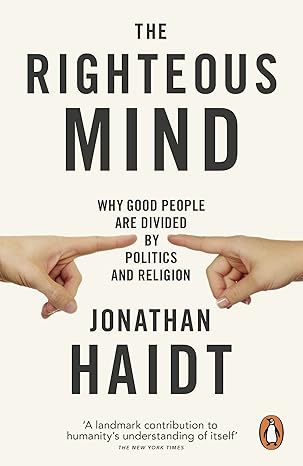
Jonathan Haidt’s The Righteous Mind arrives with a deceptively simple question: why do good, intelligent, well-meaning people end up in such bitter, unresolvable disagreement about politics and morality? After decades of research in moral psychology, Haidt’s answer overturns one of the Enlightenment’s most cherished assumptions — that moral reasoning is primarily a rational enterprise, and that disagreement therefore reflects factual error, logical failure, or motivated dishonesty. His answer is more disturbing and, in a way, more generous: moral judgements are primarily emotional and intuitive, the product of a moral sense shaped by millions of years of evolution and thousands of years of cultural tradition. Reasoning follows the intuition rather than driving it, and the differences between political and religious groups reflect not different levels of intelligence or integrity but genuinely different moral sensitivities — different weighting of different values — that are to a significant degree inbuilt.
The book’s cultural significance has only grown since its publication in 2012. In an era of accelerating political polarisation, rising tribalism, and the apparent collapse of the shared moral vocabulary that makes democratic disagreement possible, Haidt’s framework offers something genuinely rare: a scientific account of why disagreement is so intractable that is simultaneously empathetic to all parties and unsentimental about the difficulties of resolution. It does not tell us that everyone is right; it tells us that everyone is reasoning from a different subset of genuine moral concerns, and that understanding this is the precondition for anything resembling productive political engagement.
The Central Metaphor: Elephant and Rider
The organising metaphor of the book is the elephant and the rider. The rider — representing conscious, deliberate reasoning — sits atop the elephant — representing the unconscious, automatic, emotional moral intuitions that constitute most of our moral experience. The rider believes it is in control; it experiences itself as directing the elephant through the application of reason. But the reality, Haidt argues, is the reverse: the elephant moves first, driven by intuition, and the rider’s primary job is not to direct but to rationalise — to construct post-hoc justifications for where the elephant has already decided to go.
This is not a peripheral or methodological point. It is the book’s central empirical claim, supported by decades of experimental evidence in moral psychology. Haidt and colleagues showed subjects actions that were technically harmless but morally disgusting — a brother and sister having consensual sex on a camping trip, leaving no possibility of discovery or pregnancy; a family eating their dog after it was hit by a car — and watched as subjects produced rapid, confident moral judgements followed by tortured, often incoherent attempts at justification. When the justifications were shown to be inadequate, subjects did not revise their moral judgements; they simply said “I know it’s wrong, I just can’t explain why.” Haidt calls this phenomenon moral dumbfounding, and he uses it to establish the priority of intuition over reason in moral cognition.
Chapter by Chapter Analysis
The Righteous Mind is divided into three parts, each developing a different aspect of the central argument.
Part I: Intuitions Come First, Strategic Reasoning Second
Chapter 1 — Where Does Morality Come From?: Haidt opens by reviewing the historical debate between nativist accounts of morality (we are born with moral intuitions) and empiricist accounts (morality is learned entirely from experience and culture). He argues for a middle position: we are born with a moral sense — a set of emotional and cognitive capacities oriented toward certain domains — and cultural learning shapes how these capacities develop in any particular individual and society. The analogy is to language: humans are born with the capacity for language, but the particular language they speak is culturally determined.
Chapter 2 — The Intuitive Dog and its Rational Tail: The most technically detailed chapter, reviewing the experimental evidence that moral reasoning is primarily post-hoc rationalisation of intuitive judgements rather than the primary driver of those judgements. Haidt introduces the “social intuitionist model” as an alternative to the “rationalist model” that dominates moral philosophy: instead of moral reasoning producing moral judgements, moral judgements are produced by moral intuitions, and moral reasoning occurs primarily in the social domain, as a mechanism for defending positions and influencing others.
Chapter 3 — Elephants Rule: An examination of the conditions under which reasoning can influence moral judgements. The rider is not entirely without power — it can, in certain conditions, direct the elephant. But these conditions are narrow: we are most susceptible to reason-based moral change when we encounter someone who triggers positive emotional responses (an in-group member, a liked person), when we have time and motivation to reflect, and when the argument does not immediately trigger a defensive reaction. The lesson is not that reason is irrelevant but that it is far less powerful than we believe.
Chapter 4 — Vote for Me (Here’s Why): Applies the elephant-and-rider model to political cognition. Haidt reviews evidence that people’s political opinions are more strongly predicted by their emotional reactions to political stimuli — their disgust sensitivity, their response to threatening imagery — than by their stated policy preferences or their deliberate reasoning. Political reasoning is motivated reasoning: we are searching not for truth but for ammunition to defend positions we already hold.
Chapter 5 — Beyond WEIRD Morality: A pivotal chapter that challenges the cultural parochialism of Western moral psychology. WEIRD — Western, Educated, Industrialised, Rich, Democratic — societies have an unusually narrow conception of morality, focusing almost exclusively on harm and fairness. Most of the world’s cultures, and most of human history, incorporate other moral concerns — purity, hierarchy, community — that WEIRD moral psychology dismisses as irrational prejudice. This observation sets up Part II’s central argument.
Part II: There’s More to Morality than Harm and Fairness
Chapter 6 — Taste Buds of the Righteous Mind: The introduction of the Moral Foundations Theory — the claim that human moral psychology is built on multiple distinct foundations, each corresponding to a different adaptive challenge that human ancestors faced. Just as taste has multiple receptors for different chemical properties, morality has multiple “taste buds” for different ethical concerns. Haidt identifies six (though the theory is ongoing and the number may be revised): Care/Harm, Fairness/Cheating, Loyalty/Betrayal, Authority/Subversion, Sanctity/Degradation, and Liberty/Oppression.
Chapter 7 — The Moral Foundations of Politics: The most politically consequential chapter. Haidt presents data from a large online survey showing that liberals and conservatives differ not in the number of moral foundations they use, but in which ones they prioritise. Liberals weight Care and Fairness most heavily, and Liberty somewhat, while attaching relatively little weight to Loyalty, Authority, and Sanctity. Conservatives weight all six foundations more equally. This asymmetry, Haidt argues, explains why political communication across the partisan divide so often fails: liberal arguments for progressive policies are typically framed in Care and Fairness terms, which resonate with liberals but fail to engage the Loyalty, Authority, and Sanctity concerns that conservatives weight equally or more heavily.
Chapter 8 — The Conservative Advantage: Haidt extends the argument to explain why conservatives have historically been more successful in electoral politics than their demographic disadvantages might predict. Because conservative moral language engages all six foundations while liberal moral language typically engages only two or three, conservative messaging has a broader potential appeal — even to people who do not consider themselves conservative. This is not an argument that conservatives are right, but that their moral palette is more complete.
Chapter 9 — Why Are People So Damn Religious?: Applies the moral foundations framework to religion, arguing that religious practice is not primarily about metaphysical belief but about the construction of moral communities. Religion engages all six moral foundations simultaneously, providing Care (through community support), Fairness (through shared rules), Loyalty (through group identity), Authority (through sacred tradition), Sanctity (through purity practices), and Liberty (through resistance to oppressive external authority). This functional account of religion explains its persistence and its social power without requiring religious beliefs to be literally true.
Part III: Morality Binds and Blinds
Chapter 10 — The Hive Switch: Haidt introduces the concept of “groupish” behaviour — the capacity of human beings to lose their sense of individual identity in collective action, from sports crowds to religious rituals to military units. He argues that this capacity — the “hive switch” — is an evolved adaptation for cooperation and competition between groups. When the hive switch is activated, individuals become more altruistic toward in-group members, more hostile toward out-group members, and more capable of sustained collective action. He argues that this capacity explains both the extraordinary creativity of human collaboration and the extraordinary destructiveness of group conflict.
Chapter 11 — The Birth of Morality: A chapter on the evolutionary origins of moral psychology. Haidt argues that human morality evolved in two stages: an individual-level stage producing the psychology of reciprocity and fairness (largely shared with other primates), and a group-level stage in which cultural group selection produced a psychology oriented around group cohesion, shared identity, and collective action. It is this second layer that produces the Loyalty, Authority, and Sanctity foundations and that distinguishes human morality from the morality of other primates.
Chapter 12 — Can’t We All Disagree More Constructively?: The concluding chapter, which resists the temptation to offer easy solutions to political polarisation while gesturing toward conditions that might make productive disagreement more possible. Haidt argues that understanding the evolutionary and psychological origins of moral disagreement is a precondition for engaging with it productively — that you cannot persuade someone whose moral foundations you dismiss as irrational, but you might be able to engage them if you understand which foundations drive their positions and address those foundations rather than the ones you weight most heavily.
The Six Moral Foundations
Moral Foundations Theory is the book’s most influential empirical contribution. The six foundations represent distinct psychological systems, each tracking a different category of moral concern and each with an evolutionary origin in the adaptive challenges of social life:
Liberal vs. Conservative Moral Palettes
The most practically important finding of Haidt’s research is the systematic difference in how liberals and conservatives weight the six foundations. This is not a difference in moral intelligence or moral seriousness — both groups care about morality deeply. It is a difference in the range of moral concerns each group recognises as legitimate:
Understanding this difference has immediate practical implications. When a progressive argues for a policy using Care and Fairness language alone, they are literally not speaking to three of the moral concerns that motivate a conservative’s position. The conservative hears the argument not as compelling or compelling-but-wrong but as speaking a different moral language — addressing concerns the conservative does not recognise as the relevant ones. The reverse is equally true: conservative arguments framed in Authority and Loyalty terms often fail to engage liberals who weight those foundations lightly. Haidt’s prescription is not to abandon one’s values but to translate them — to make the Care and Fairness implications of progressive policies explicit to conservatives, and to make the Loyalty and Authority implications of conservative policies explicit to progressives.
Main Arguments & Insights
1. Moral Reasoning Is Post-Hoc Rationalisation: The book’s most provocative claim — that reason is the servant of intuition rather than its master — overturns the Enlightenment model of moral cognition and has substantial empirical support. It implies that the standard mode of political persuasion (presenting arguments and evidence) is largely ineffective, and that effective moral communication must engage emotional and intuitive responses rather than simply logical ones.
2. Morality Is Multi-Dimensional: The reduction of morality to harm-prevention and fairness, which characterises WEIRD moral psychology and much of academic moral philosophy, misses the majority of the moral concerns that have motivated most of human history. Loyalty, authority, and sanctity are not irrationalities or corruptions of morality; they are genuine moral sensitivities serving genuine social functions. Any moral psychology that ignores them will misunderstand most of the moral behaviour of most of humanity.
3. Political Disagreement Is Rooted in Different Moral Palettes, Not Different Levels of Intelligence or Integrity: This claim is Haidt’s most practically important contribution to political discourse. If political opponents are not stupid, evil, or dishonest — merely weighting different genuine moral concerns differently — then the appropriate response to disagreement is understanding rather than contempt. This does not mean all positions are equally valid; but it means that the path to persuasion runs through genuine engagement with the other side’s actual concerns, not through dismissal of those concerns as irrational.
4. Humans Are 90% Chimp, 10% Bee: Haidt’s formulation of human nature combines the individual competition of our primate heritage with the group cooperation that cultural group selection has layered on top. We are simultaneously self-interested and capable of genuine group loyalty — not as a contradiction but as a dual inheritance. The hive switch is real; moments of collective transcendence — religious rituals, sporting victories, military solidarity — are not illusions but expressions of an evolved capacity for group cohesion that is one of the most distinctive features of the human species.
Critical Reception & Perspectives
The Righteous Mind was widely praised on publication and has since become one of the most-cited works in political psychology and political communication. It won the Goodreads Choice Award for Nonfiction in 2012 and has been adopted as required reading in university courses ranging from political science to organisational behaviour to design. Critics across the political spectrum acknowledged the empirical rigor of the moral foundations research and the explanatory power of the elephant-and-rider framework.
However, the book attracted pointed criticisms from multiple directions. Some liberals argued that Haidt’s framework is implicitly conservative in its effect — by presenting the conservative moral palette as “more complete” (using all six foundations rather than two or three), he implicitly validates moral concerns like purity and authority that progressives believe should be recognised as rationalised forms of prejudice. Haidt has responded that his empirical claim about what people actually find morally relevant is distinct from any normative claim about what people should find morally relevant, but the tension remains real.
From within social psychology, critics noted that Moral Foundations Theory, while influential, is not the only or the most validated framework for moral psychology. Jonathan Haidt’s former student Jesse Graham and others have raised questions about the theory’s empirical foundations, the number and definition of the foundations, and the reliability of the measurement instruments used in cross-cultural research. The theory is better described as a productive research programme than an established scientific consensus.
Perhaps the most interesting criticism comes from those who argue that Haidt’s therapeutic framing — his recommendation that understanding the other side’s moral foundations will help with political communication — understates the extent to which genuine conflicts of interest and genuine moral disagreements, rather than mere differences of emphasis, drive political conflict. Not all political disagreement can be dissolved by better translation; some disagreements involve real incompatibilities between values, not just different weightings of shared ones.
Real-World Examples & Implications
-
Political Messaging: The most direct application of the book is to political communication. Research building on Haidt’s framework has shown that progressive environmental messaging framed in terms of purity and sanctity (“Keep our sacred lands clean”) is more effective with conservative audiences than the same message framed in harm terms. Similarly, conservative economic arguments framed in fairness terms are more effective with liberal audiences than the same arguments framed in liberty terms. The insight that you must speak to the moral foundations your audience actually uses, not just the ones you weight most heavily, has influenced political campaign strategy on both sides.
-
Cross-Cultural Business: Understanding that different cultures weight moral foundations differently has practical applications in international business. A corporate culture that emphasises individual merit and fairness (weighting Fairness heavily) may generate discomfort and resistance in a culture that weights Authority and Loyalty more heavily. Haidt’s framework helps explain why value conflicts in multinational organisations are so persistent and why simple policy standardisation is rarely the solution.
-
Mediation and Conflict Resolution: The elephant-and-rider model has practical implications for mediation: if moral positions are primarily driven by intuition, and reasoning is primarily defensive, then traditional argument-focused mediation will be less effective than approaches that work with the emotional and intuitive foundations of the conflict first. Some mediators have begun incorporating Haidt’s framework explicitly into their practice.
-
Social Media and Outrage: The hive switch concept provides a framework for understanding the dynamics of social media outrage: platforms that trigger the in-group/out-group psychology encoded in the Authority, Loyalty, and Sanctity foundations — by circulating stories of betrayal, contamination, and hierarchical transgression — reliably activate the group-polarising dynamics that make tribal conflict more intense. This is not an accident of algorithm design; it is a predictable consequence of designing for engagement without understanding the psychology of moral outrage.
Suggested Further Reading
-
Thinking, Fast and Slow by Daniel Kahneman (2011) The comprehensive account of the System 1/System 2 distinction that underlies Haidt’s elephant-and-rider metaphor. Kahneman’s book provides the cognitive science foundation for the claim that intuition precedes and dominates deliberate reasoning. View on Goodreads | Read our summary
-
The Lessons of History by Will & Ariel Durant (1968) A complementary perspective on the recurring structures of human political and moral life across civilisations, providing historical context for Haidt’s evolutionary account of moral foundations. View on Goodreads | Read our summary
-
Man’s Search for Meaning by Viktor Frankl (1946) Frankl’s account of how human beings construct meaning in extreme conditions provides a different but compatible perspective on the non-rational foundations of moral experience and the limits of purely cognitive approaches to ethics. View on Goodreads | Read our summary
-
Meditations by Marcus Aurelius (circa 170 AD) A practical engagement with the challenge of acting ethically in a world of competing interests and imperfect information, by a philosopher who understood that moral behaviour is a practice rather than a conclusion. View on Goodreads | Read our summary
-
Sapiens by Yuval Noah Harari (2011) Harari’s account of how shared myths and collective beliefs have enabled human cooperation at scale provides a civilisational-level parallel to Haidt’s evolutionary account of how moral psychology enables cooperation at the group level. View on Goodreads | Read our summary