Editorial Note
At 100 pages, this is the most concentrated dose of historical wisdom I've encountered. Written by two people who had spent 40 years writing an 11-volume history of civilisation. Every sentence has weight. Read it slowly.
Harris F.
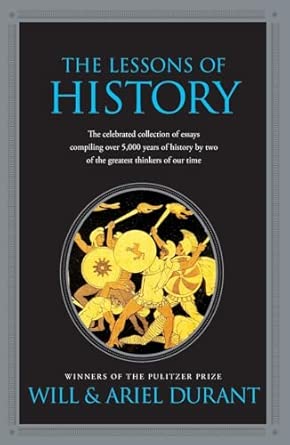
Will and Ariel Durant spent forty years writing their monumental Story of Civilization — eleven volumes, nearly ten thousand pages, covering the full sweep of human history from prehistoric times to the Napoleonic era. The Lessons of History, published in 1968, was their attempt to distil that lifetime of scholarship into a single small volume: 102 pages identifying the patterns, principles, and ironies that history repeats across cultures, centuries, and continents. The result is one of the most concentrated pieces of intellectual nonfiction ever written. Every page carries the weight of the four decades and ten thousand pages behind it. Reading it feels less like reading a book and more like having a conversation with someone who has spent a lifetime learning to see the shape of human affairs.
The book’s value lies not in its conclusions, which are sometimes uncomfortable and often contested, but in its method. The Durants approach history empirically — as evidence from which inferences can be drawn — rather than ideologically. They are not trying to confirm a theory; they are trying to identify what actually recurs. The result is a book that challenges readers across the political spectrum: conservatives will find their faith in tradition and hierarchy validated; progressives will find their aspirations for equality and social improvement supported; and everyone will find several of their assumptions about uniqueness and progress quietly punctured by the observation that every generation believes itself to be the first to understand something that humanity has been learning and forgetting for five thousand years.
The Scale of the Achievement
The Story of Civilization project began in 1935 with Our Oriental Heritage and concluded in 1975 with The Age of Napoleon. The Durants wrote it together, with Ariel handling much of the research and Will providing the literary architecture. Together they received the Pulitzer Prize for General Nonfiction in 1968 — the same year The Lessons of History appeared — for Rousseau and Revolution, the tenth volume in the series. The project represents a form of scholarship that is virtually impossible in the modern academic environment: synthesis rather than specialisation, breadth rather than depth, aimed at the educated general reader rather than the domain expert.
The Lessons of History is the philosophical capstone of that project. In thirteen short chapters, the Durants address what history teaches about geography, biology, race, character, morality, religion, economics, socialism, government, war, growth, decay, and progress. Each chapter is dense with examples drawn from across the full range of civilisations they had studied, from ancient China and Mesopotamia through classical Greece and Rome, the Renaissance, the Enlightenment, and the modern era. The effect is vertiginous — and humbling.
Chapter by Chapter Analysis
Chapter 1 — History and the Earth: The Durants open with geography as the foundation of history. Climate, topography, and access to waterways determine which civilisations can arise, how they will trade, where they will fight, and how their economies will develop. They note, however, that geography’s determinism weakens as technology advances: canals, railways, aircraft, and communications progressively liberate civilisation from purely geographic constraints. The lesson is that geography explains the first move in history’s game but not the endgame.
Chapter 2 — Biology and History: A bracing chapter arguing that the laws of biology underlie the laws of history. Life is competition; cooperation exists, but within a larger competitive frame. Inequality of ability is natural; the dream of absolute equality runs against the grain of every organism’s differential endowment of energy, intelligence, and luck. The Durants note that birth rates tend to be inversely correlated with income and education, meaning that evolution, within any given generation, may select against the traits that produced the civilisation — a sobering observation that they treat with characteristic equanimity.
Chapter 3 — Race and History: One of the more carefully argued chapters, in which the Durants reject racial determinism while acknowledging the historical reality of group differences in cultural achievement. They argue that observed differences in civilisational accomplishment are better explained by geography, history, and cultural accumulation than by innate biological factors, and that the historical record shows too many cases of great civilisations from every major racial group to support the racial theories fashionable in their time (and, one might add, periodically revived since).
Chapter 4 — Character and History: Examines the role of individual psychology in historical causation. The Durants note that human nature — its blend of aggression, acquisitiveness, sociality, and creativity — changes very slowly over historical time, while social structures change relatively rapidly. This creates a tension: every generation inherits a human nature shaped by hundreds of thousands of years of evolution and must construct social institutions capable of channelling it productively. The lesson is that social reforms that ignore human nature will fail; reforms that work with it can endure.
Chapter 5 — Morals and History: One of the book’s most subtle chapters, tracing the historical variation in moral codes while identifying what the Durants consider the cross-cultural moral minimum: prohibitions on murder, theft, and incest that appear in virtually every human society. They argue that moral codes are practical adaptations to social conditions: the sexual permissiveness of hunter-gatherer societies becomes the strict regulation of agrarian ones because property and inheritance require paternity certainty. Moral relaxation tends to follow security and wealth; moral stringency tends to accompany insecurity and competition.
Chapter 6 — Religion and History: The Durants treat religion with the respect owed to a social institution that has survived for the entirety of recorded human history. They argue that religion has served essential social functions — providing moral codes, community cohesion, comfort in the face of death, and a check on purely acquisitive behaviour — and that the weakening of religious authority in modern times has not yet produced a satisfactory secular substitute for these functions. They predict, with some prescience, that the decline of religious faith would produce moral and social fragmentation.
Chapter 7 — Economics and History: History, the Durants argue, is fundamentally economic: the struggle over the production and distribution of goods underlies most political conflict, most wars, and most social movements. They identify the persistent tendency of wealth to concentrate in the hands of a small minority in any developed economy, and the equally persistent tendency of this concentration to generate resentment, revolutionary pressure, and ultimately redistribution — whether through progressive taxation, inflation, or outright revolution.
Chapter 8 — Socialism: A compact survey of the history of socialist ideas and experiments, from ancient Sparta through the medieval church to the Soviet Union. The Durants conclude that pure socialism is impossible — it conflicts too directly with the competitive and acquisitive elements of human nature — but that mixed economies incorporating socialist elements of redistribution and collective provision have proven more stable than either pure capitalism or pure socialism. They note, characteristically, that this conclusion was reached by several ancient civilisations long before the modern debate.
Chapter 9 — Government: A typology of political forms — monarchy, oligarchy, democracy, tyranny — and their historical transitions. The Durants observe that democracy, while normatively attractive, is historically rare and fragile: it requires an educated, economically secure citizenry and tends to evolve either toward plutocracy (rule by the wealthy) or toward the demagoguery that precedes tyranny. The famous observation appears here: “If the equality of income and leisure could be established, democracy might survive; but the combination of inequality and liberty is itself, in turn, a generator of inequality.” History’s default political form is not democracy but some variety of oligarchy.
Chapter 10 — War and History: A sobering catalogue of war’s ubiquity across human history — the Durants count 268 years of peace in 3,421 years of recorded history — and a sober assessment of what war has achieved and destroyed. They argue that war, though horrible, has been the primary driver of political change and civilisational consolidation: most large political units were created by conquest. The lesson is not that war is good, but that the desire for peace, however genuine, must be reconciled with the competitive structures that make war probable.
Chapter 11 — Growth and Decay: The chapter examines the historical pattern of civilisational rise and fall. The Durants identify a recurring arc: civilisations arise through the creativity and energy of a founding generation, expand through the competence and inheritance of subsequent ones, peak in cultural achievement, and decline as the underlying adaptive challenges are mastered and the population becomes comfortable, divided, and vulnerable to internal or external disruption. They resist the conclusion that decline is inevitable, noting cases of civilisations that renewed themselves — but acknowledge that renewal requires the same creative energy as the original founding, which is always rare.
Chapter 12 — Is Progress Real?: One of the most personally revealing chapters, in which the Durants defend the idea of progress against the fashionable despair of the mid-twentieth century. They define progress not as moral perfection or the elimination of suffering, but as the accumulation of tools — biological, cultural, technological, institutional — that give individuals and societies more control over their circumstances. By this measure, progress is real: the average human life in the twentieth century, whatever its anxieties, commanded more knowledge, comfort, and opportunity than the average life in any previous century. The lesson is that progress is fragile, never assured, and always partial — but it is real.
Chapter 13 — Is History the Guide?: The concluding chapter, which addresses the question of the book itself: can historical patterns actually teach us anything useful? The Durants’ answer is measured: history cannot predict the future, but it can make us less surprised by it. It can identify the pressures that tend to generate particular outcomes — inequality generating redistribution, centralised power generating resistance, comfort generating fragility — without telling us when or how those outcomes will arrive. The appropriate posture is neither the hubris of thinking we can control history nor the despair of thinking it is meaningless, but the qualified wisdom of a student who has studied many examples without mastering the subject.
The Civilisation Lifecycle
A thread woven through multiple chapters is the Durants’ observation of a recurring civilisational lifecycle — a pattern of birth, growth, maturity, and decline that appears across cultures so different in language, religion, and geography that the pattern cannot be cultural accident. The Durants are careful not to present this as a mechanical law: civilisations can arrest their decline, renew themselves, or be absorbed into new configurations. But the arc recurs often enough to be taken seriously as a template.
The Inequality Problem
Among the book’s most challenging claims is its treatment of economic inequality. The Durants argue, on the basis of historical observation across five thousand years, that the tendency of wealth to concentrate is not a political failure or a systemic aberration: it is a natural consequence of the differential distribution of talent, energy, and luck that characterises any population. Left to its own devices, any free economic system will generate increasing inequality. This is not, they stress, an argument for accepting inequality as just — only an argument for accepting it as recurrent. The historical pattern shows that extreme inequality generates pressure for redistribution, which relieves the pressure temporarily, after which the natural tendency toward concentration reasserts itself. The cycle has repeated so many times and in so many different political systems that the Durants treat it as close to a law of social dynamics.
Main Arguments & Insights
1. History Rhymes, Not Repeats: The Durants do not argue that history is literally cyclical — the same events recurring in the same order. They argue that similar pressures, applied to similar human natures, tend to produce similar patterns, with endless variation in the details. Knowing the pattern does not let you predict the specific event, but it allows you to recognise the pressure when you feel it and to be less surprised by the outcome.
2. Human Nature Is the Constant: Across all the variation in political systems, economic arrangements, religious beliefs, and cultural practices, the Durants find a remarkably stable human nature: competitive, acquisitive, social, curious, capable of extraordinary cooperation and extraordinary cruelty. Social institutions that channel this nature productively succeed; those that attempt to suppress or redesign it fail. This is one of the book’s most important practical lessons for social reformers.
3. The Concentration Tendency Is Inescapable: Perhaps the book’s most politically uncomfortable argument: that economic inequality is not primarily a product of policy failure but of the natural operation of economic systems on unequally endowed human beings. The Durants present this neither as a defence of the wealthy nor as a counsel of despair, but as a factual observation that should inform realistic policy design.
4. Progress Is Real But Fragile: Against the fashionable pessimism of their era — and ours — the Durants defend the reality of progress, defined as the accumulation of tools that expand human capability and reduce suffering. But they stress that progress is not guaranteed, not irreversible, and not linear. It must be actively maintained, and the conditions that produce it — political stability, cultural openness, institutional trust — can be destroyed more quickly than they can be built.
Critical Reception & Perspectives
The Lessons of History was received as a remarkable distillation of a remarkable intellectual project. Critics praised the elegance and compression of the prose — the ability to make a serious historical argument in fewer than twenty pages on each major theme — and the extraordinary breadth of the reference material. The book was adopted as required reading in several university courses and became one of the most frequently cited works in discussions of the uses and limits of historical knowledge.
Critics of the book tend to focus on three areas. First, the scope of the synthesis inevitably involves simplification: scholars of individual periods and civilisations have noted that the Durants’ generalisations sometimes flatten important distinctions. A historian of ancient China may find the treatment of Asian civilisations cursory; a specialist in Islamic history may find the discussion of religious dynamics too Western-centric. These are fair criticisms that the Durants would probably acknowledge — synthesis requires selective emphasis, and no two historians would draw the same lessons from the same evidence.
Second, some of the book’s empirical claims, particularly in the chapters on biology and race, reflect the scientific consensus of the 1960s in ways that subsequent research has complicated. The Durants were careful and intellectually honest for their era, but the fields of genetics, evolutionary psychology, and historical economics have advanced considerably since 1968, and some of the factual substructure of the argument requires updating.
Third, and most interestingly, the book’s political philosophy is genuinely hard to categorise, which has led to discomfort on both left and right. Conservatives appreciate the Durants’ scepticism of utopian social reform and their respect for traditional institutions; progressives appreciate their sympathy for redistribution and their rejection of racial hierarchy. Libertarians are frustrated by their acceptance of the necessity of government; authoritarians are frustrated by their qualified defence of democracy. The book’s intellectual integrity lies precisely in this discomfort with easy political categorisation.
Real-World Examples & Implications
-
The 2008 Financial Crisis and Wealth Concentration: The Durants’ observation that wealth concentration is historically persistent and generates redistributive pressure was validated dramatically by the post-2008 political landscape. The concentration of gains in the recovery and the stagnation of middle-class incomes in the United States and United Kingdom generated exactly the political pressure — expressed variously as Occupy Wall Street, Brexit, and the rise of populist movements across the political spectrum — that the Durants’ framework would predict.
-
The Decline of Institutional Trust: The Durants’ argument that declining religious authority, without an adequate secular substitute, produces moral fragmentation looks increasingly prescient in the context of the decline in institutional trust — in governments, media, universities, and corporate authority — that has characterised the early twenty-first century. The “existential vacuum” that Frankl identified at the individual level parallels the civic vacuum the Durants identified at the collective level.
-
The Resilience of Oligarchy: The Durants’ observation that the default political form is oligarchy rather than democracy finds sobering resonance in political science research showing that policy outcomes in nominally democratic systems correlate more strongly with the preferences of economic elites than with the preferences of the median voter. The observation is not a counsel of despair — democracy is worth defending and expanding — but it is a reminder that democratic institutions require active maintenance.
-
The Creativity of Adversity: The Durants’ observation that the most creative periods of civilisational history tend to follow disruption — the Renaissance following the Black Death, the Scientific Revolution following the Wars of Religion — provides historical context for the argument, developed elsewhere in the literature, that struggle and uncertainty, rather than comfort and security, are the conditions under which human creativity flourishes most reliably.
Suggested Further Reading
-
Sapiens: A Brief History of Humankind by Yuval Noah Harari (2011) The closest modern equivalent to the Durants’ synthesis project: a single narrative encompassing the full sweep of human history, with particular attention to the role of shared myths, institutions, and cognitive capacities. View on Goodreads | Read our summary
-
The Changing World Order by Ray Dalio (2021) Applies the Durants’ pattern-recognition approach to the specific dynamics of empires, reserve currencies, and geopolitical transition, with detailed data on the cycles of rise and decline the Durants described qualitatively. View on Goodreads | Read our summary
-
Guns, Germs, and Steel by Jared Diamond (1997) Develops the geographic determinism thread of The Lessons of History into a full-length argument about why different civilisations developed at different rates, drawing on archaeology, ecology, and linguistics. View on Goodreads | Read our summary
-
The Decline of the West by Oswald Spengler (1918) The most famous predecessor to the Durants’ civilisational-pattern argument, more deterministic and more pessimistic. Reading Spengler alongside the Durants illuminates the range of ways the same historical evidence can be interpreted. View on Goodreads
-
Thinking, Fast and Slow by Daniel Kahneman (2011) Provides the psychological framework for understanding why the “character is constant” argument the Durants make is supported by cognitive science: the systematic biases and heuristics Kahneman documents are as old as the brain that generates them. View on Goodreads | Read our summary