Editorial Note
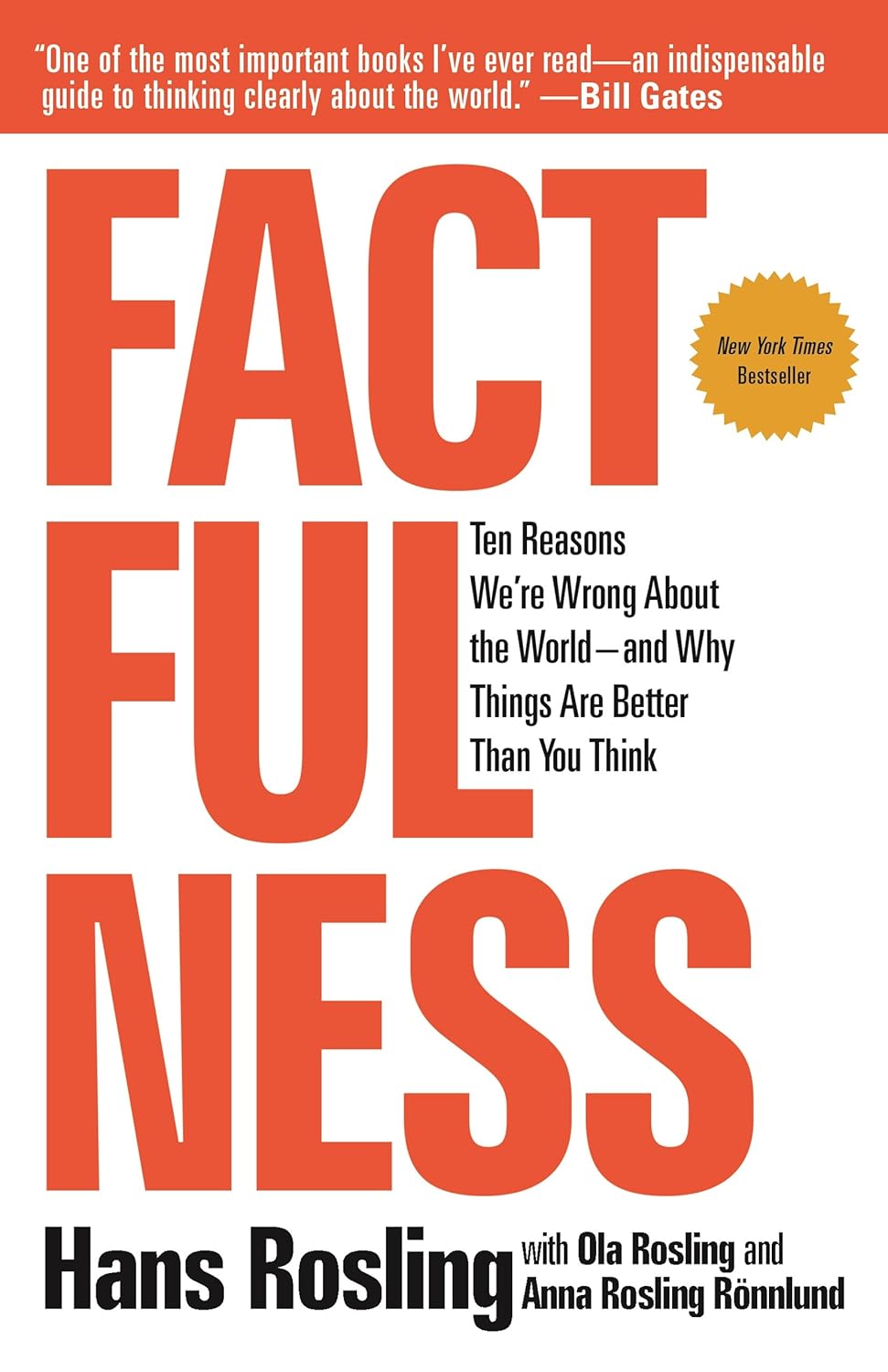
Rosling died before this was published, which gives it an odd warmth. He was furious at how wrong educated people are about global progress, and that controlled fury makes the book more compelling than its data-heavy premise suggests. The best antidote to doom-scrolling I've found.
Harris F.
In an era defined by 24-hour news cycles and alarmist headlines, Factfulness serves as a crucial intellectual intervention. Hans Rosling, a physician and statistician, dedicated his life to battling global ignorance with data. The core thesis of the book is that the vast majority of human beings—including Nobel laureates and global leaders—hold a devastatingly inaccurate worldview. We tend to believe the world is poorer, less healthy, and more dangerous than it actually is. Rosling argues that this isn’t just a matter of lacking knowledge; it is a result of evolutionary instincts that bias us toward drama and negativity.
This book matters because it offers a “stress-reducing habit” for the mind. By understanding the ten specific instincts that distort our perspective, we can stop reacting to the world with fear and start responding with constructive action. It replaces the lazy, binary label of “developed vs. developing” with a pragmatic framework of Four Income Levels, transforming how we understand global markets, public health, and human progress. It is not a book about optimism; it is a book about reality.
![Diagram of [Concept]](/images/factfulness/concept.svg)
Chapter by chapter analysis
Rosling structures the book around ten dramatic instincts that prevent us from seeing the world factually.
1. The Gap Instinct
This is the tendency to divide all things into two distinct, often conflicting groups, with an imagined gap between them (e.g., “The West” vs. ” The Rest,” “Rich” vs. “Poor”). Rosling demonstrates that the data shows a continuum, not a gap. The majority of the world’s population actually lives in the middle, not at the extremes.
2. The Negativity Instinct
We notice the bad more than the good. Evolutionarily, attending to danger was necessary for survival. Today, however, we are subjected to selective reporting by media that monetizes fear. Rosling highlights that while things can be bad, they can simultaneously be better than they were before (e.g., extreme poverty rates have halved in the last 20 years).
3. The Straight Line Instinct
When we see a line going up (like population growth), we assume it will continue in a straight line forever. This leads to panic about overpopulation. Rosling uses demographic data to show that population growth is already slowing down and will plateau as nations move up income levels and families have fewer children.
4. The Fear Instinct
Our brains are hardwired to pay attention to frightening things: physical harm, captivity, and contamination. This instinct distorts our risk assessment. We fear terrorism, sharks, and plane crashes—events that kill very few people—while ignoring boring but deadly risks like heart disease or drunk driving.
5. The Size Instinct
We tend to get things out of proportion, especially when we see a lonely number on its own. A number like “4.2 million babies died” sounds horrific (and it is), but without comparing it to the number from the previous year (which was higher), we cannot judge progress. Rosling teaches us to always ask: “Compare to what?“
6. The Generalization Instinct
Everyone automatically categorizes and generalizes to function. However, this leads to stereotypes that blind us to reality. Rosling warns against “aggressive generalization,” particularly regarding cultures or countries we are unfamiliar with. He urges readers to look for differences within groups and similarities across groups.
7. The Destiny Instinct
This is the idea that innate characteristics determine the destinies of people, countries, religions, or cultures. It makes us believe that Africa is “doomed” to poverty or that certain religions are incompatible with democracy. Rosling argues that societies and cultures are in constant flux; slow change is not the same as no change.
8. The Single Perspective Instinct
We love simple ideas and single solutions. Whether it’s the free market or total equality, we are attracted to a single cause and a single cure. Rosling advises maintaining a “toolbox” of perspectives. A hammer is great for nails, but terrible for cleaning windows. Complex problems require nuance, not ideology.
9. The Blame Instinct
When things go wrong, we want to find a clear, simple reason—usually a bad person. This instinct prevents us from understanding the system. If we blame a “greedy CEO” or a “lying politician,” we stop looking for the systemic causes that would allow the problem to persist regardless of who is in charge.
10. The Urgency Instinct
This is the “now or never” feeling. It shuts down our analytical faculties and triggers a fight-or-flight response. While useful for immediate physical danger, it leads to bad long-term decision-making in complex scenarios (like climate change or business strategy). Rosling advises: “Take a breath. It is rarely now or never.”
Main Arguments & Insights
The Four Income Levels
Perhaps the most enduring contribution of Factfulness is the dismantling of the “Developing vs. Developed” world model. Rosling proposes replacing this outdated binary with four income levels:
- Level 1 ($1/day): Extreme poverty. Walking barefoot, cooking over open fire, struggling for food. (~1 billion people).
- Level 2 ($4/day): You have shoes, maybe a bike. You cook with gas. Children go to school but might drop out for work. (~3 billion people).
- Level 3 ($16/day): You have a motorbike, running water, a fridge. You can afford a vacation occasionally. (~2 billion people).
- Level 4 ($64+/day): You have a car, reliable electricity, hot water, and can afford to fly. (~1 billion people).
Most of the world is now on Level 2 or 3, drastically changing the narrative of global inequality.
”Bad” and “Better” Can Coexist
One of the hardest mental shifts is accepting that the world is not strictly “good” or “bad.” Rosling uses the analogy of a premature baby in an incubator. The baby’s health status is bad (critical condition), but if the vitals improve slightly, it is better. We must hold two thoughts simultaneously: the state of the world can be tragic (bad) while the trajectory is positive (better). Failing to acknowledge progress results in apathy; failing to acknowledge the remaining suffering results in complacency.
The Media is a Filter, Not a Mirror
The book argues that the media is structurally incapable of presenting a neutral view of the world.
“Good news is not news.” Gradual improvements—like fewer plane crashes, better literacy rates, or the eradication of diseases—rarely make headlines because they happen slowly. Conversely, singular dramatic events (war, terrorism, natural disasters) fit the “breaking news” format perfectly. Consequently, the more news you consume, the more likely you are to have a distorted, negative view of reality.
The Population “Explosion” is Over
The intuition that saving lives leads to overpopulation is false. The data proves the opposite: as countries move from Level 1 to Level 2 and 3, child mortality drops. When parents realize their children will survive, and as women gain access to education and contraceptives, family sizes drop rapidly. The global population is growing not because people are having more babies, but because the existing population is living longer. We have already reached “Peak Child”—the number of children in the world has stopped increasing.
Beware of the “Rearview Mirror”
Rosling warns that our textbooks and worldviews are often outdated by decades. Westerners often view the world through data from the 1970s or 80s, perceiving the “West” as the sole driver of the economy. In reality, the “Old West” (North America and Europe) makes up a shrinking minority of the global economy. The future markets are in Asia and Africa (Levels 2 and 3 moving to 4), and failing to recognize this growth is a massive business risk.
![Diagram of [Concept]](/images/factfulness/summary.png)
Critical Reception & Perspectives
The Praise: Factfulness was widely celebrated upon release. Bill Gates famously offered a free copy to every graduating college student in the US, calling it “one of the most important books I’ve ever read.” Critics and readers alike praised its accessible data visualization and its ability to provide hope without being naïve. It is considered a seminal text in the “New Optimism” or “Rational Optimism” movement.
The Critique: Despite its popularity, the book has faced valid criticism.
- Environmental Concerns: Critics argue Rosling downplays the severity of the climate crisis (The Urgency Instinct) in a way that might encourage inaction.
- Inequality within Levels: While the gap between countries is closing, inequality within countries (especially in Level 4 nations) is rising, which the “4 Levels” model doesn’t fully capture.
- Neoliberal Bias: Some sociologists argue the book assumes that the Western trajectory of industrialization is the only valid path for development, ignoring cultural losses or the sustainability of everyone living at Level 4 consumption habits.
Real-World Examples & Implications
How do Rosling’s insights translate to daily life and business?
-
For Business Strategy:
-
Target the Middle: Don’t just design products for Level 4 (the rich). The biggest growth markets are the 5 billion people in Levels 2 and 3. Companies like IKEA and Unilever succeed by creating products specifically for these consumers (e.g., single-use shampoo packets).
-
Global Investment: Stop viewing Africa and Asia as charity cases. They are the fastest-growing economies. Treat them as investment opportunities.
-
For Media Consumption:
-
The 50-Year Rule: When you see a scary statistic, look for the trend line. Is this a spike, or is the long-term trend actually going down?
-
Ignore the “Average”: Averages hide spreads. If you see a spread of data (e.g., income inequality), the “average” income might not represent anyone’s actual reality.
-
For Personal Well-being:
-
Fact-Check Your Fear: When you feel anxiety about the state of the world, ask yourself: “Am I seeing a selection of the worst events, or a representative sample?”
-
Humble Curiosity: Be prepared to update your knowledge. If your facts about the world are from school 20 years ago, they are likely wrong.
Suggested Further Reading
-
Enlightenment Now by Steven Pinker - A deeper historical dive into why reason, science, and humanism have led to the greatest era of human flourishing. View on Goodreads
-
The Rational Optimist by Matt Ridley - Focuses on how trade and specialization have driven prosperity and why human exchange makes innovation inevitable. View on Goodreads
-
Thinking, Fast and Slow by Daniel Kahneman - The foundational text on why our brains rely on the cognitive biases (instincts) that Rosling describes. View on Goodreads | Read our summary
Final Thought: “Factfulness is the stress-reducing habit of only carrying opinions for which you have strong supporting facts.”
Would you like me to generate a similar summary for “Thinking, Fast and Slow” to complement this analysis?