Editorial Note
Taleb is insufferable in the best possible way. He repeats himself, name-drops constantly, and somehow you come away thinking differently about almost everything. The core idea -- that some things do not just survive chaos, they need it -- is one of those concepts you cannot unlearn.
Harris F.
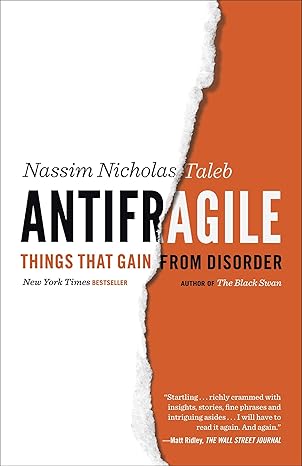
Nassim Nicholas Taleb’s Antifragile is the book that introduced a concept the English language did not previously possess. Before Taleb, we had words for things that break under stress (fragile) and things that resist it (robust), but no word for things that actually benefit from disorder, uncertainty, and volatility. The absence of this word was, Taleb argues, the absence of an idea — and the absence of the idea had been blinding us to one of the most fundamental properties of natural and human systems. In everything from human muscles to financial portfolios, from immune systems to political institutions, some entities don’t merely survive disruption: they grow stronger from it. Taleb calls this property antifragility, and understanding it changes how you think about risk, planning, innovation, and the nature of knowledge itself.
The book’s significance extends far beyond its central concept. Antifragile is a sustained philosophical argument against what Taleb calls Platonification — the modern tendency to replace the messy, complex reality of the world with elegant but dangerously simplified models of it. The financial crisis of 2008, chronic diseases caused by over-medicated bodies, the failures of centralised economic planning — Taleb attributes all of these to the same error: systems designed by people who confused their models of reality for reality itself, and who eliminated the volatility and randomness that natural systems need to stay healthy. Antifragile is simultaneously a theory of resilience, a critique of modernity, and a practical philosophy for navigating uncertainty.
The Core Taxonomy
Taleb’s central framework divides the world into three categories, each representing a fundamentally different relationship with disorder and uncertainty:
-
Fragile — entities that are harmed by volatility and stress. They require calm, predictability, and stability to function. When subjected to randomness, they break. Most modern institutions — supply chains optimised for efficiency rather than resilience, financial systems built on thin liquidity buffers — are fragile. Glass is fragile.
-
Robust — entities that are indifferent to volatility. They neither benefit from nor are harmed by shocks within a reasonable range. They resist disruption. Rocks are robust. Simple rules are robust. Systems with redundancy are robust.
-
Antifragile — entities that gain from disorder, volatility, and stress. They are not merely resilient; they need the stressor to develop. Human muscles are antifragile — they grow stronger in response to resistance. Evolution is antifragile — it requires the random variability of mutation and the culling pressure of selection. Options in finance are antifragile — they gain from extreme moves in either direction.
Chapter by Chapter Analysis
Antifragile is structured as seven “books” within the larger work, each developing the central argument from a different angle.
Prologue — Between Damocles and Hydra: Taleb opens by contrasting two mythological figures. Damocles, who sits under a sword suspended by a single thread, represents fragility — a system with extreme downside and no upside from volatility. The Hydra, which grows back two heads for every one cut off, represents antifragility. The prologue establishes Taleb’s central claim: that modern civilisation, in its obsession with efficiency and prediction, has systematically moved from Hydra-like resilience toward Damocles-like fragility — eliminating the small, frequent shocks that keep systems healthy in order to avoid short-term disruption, and thereby creating the conditions for catastrophic failure.
Book I — The Antifragile: An Introduction: The first section introduces the core taxonomy and makes the case that antifragility is not a marginal property but a fundamental feature of how complex systems — biological, economic, social — actually work. Taleb argues that the desire to eliminate all volatility and uncertainty from a system is not safety; it is the suppression of the feedback mechanisms the system needs to self-correct. A forest that is never allowed to burn small fires accumulates fuel for catastrophic ones. A financial system that is never allowed to experience small failures accumulates the fragility for systemic collapse. Taleb introduces the metaphor of Procrustes’s bed — the tendency to force reality to fit our models rather than updating our models to fit reality.
Book II — Modernity and the Denial of Antifragility: This section examines how modern institutions systematically destroy antifragility. Taleb coins the term Neomania for the modern fetishisation of novelty and intervention, arguing that most modern “improvements” are actually forms of fragility transfer — they make individuals and corporations more comfortable in the short term by making the underlying system more vulnerable in aggregate. He introduces the distinction between naive intervention (acting without understanding second-order effects) and the more principled approach of the via negativa — improving systems by removing harmful elements rather than adding new ones. The chapter on medicine is particularly striking: Taleb argues that the medical establishment’s aggressive interventionism in low-stakes conditions is a form of iatrogenic harm — damage caused by the healer.
Book III — A Non-Predictive View of the World: Taleb here challenges the entire enterprise of economic and social forecasting. He argues that predictions of complex systems are not merely often wrong — they are systematically wrong in a particular direction: they underestimate the tails of distributions, the rare but extreme events that drive most of history’s important changes. Rather than predicting the future, Taleb advocates for building systems that do not depend on prediction — systems that can handle a range of scenarios, particularly the bad ones. He introduces the concept of the black swan (developed at length in his previous book) and connects it to antifragility: rather than trying to predict black swans, build structures that benefit from or at least survive them.
Book IV — Optionality, Technology, and the Intelligence of Antifragility: The most practically important section, which argues that options — in the broadest sense of the word — are the mechanism by which antifragile systems exploit volatility. An option gives you the right but not the obligation to take an action; its value increases as uncertainty increases. Evolution “holds” options: genetic variation creates a range of phenotypes, some of which will thrive in any given environment. Entrepreneurs hold options: by making small bets, failing fast, and reinvesting in what works, they profit from uncertainty. Taleb argues that much of human technological and economic progress has been driven not by planned research but by trial-and-error experimentation that looks more like option-holding than prediction-following.
Book V — The Nonlinear and the Nonlinear: Taleb makes a technical but important argument about convexity. A fragile system has concave exposure to events: a given shock does more harm than a shock of twice the size does good. An antifragile system has convex exposure: a given shock does more good than harm. This asymmetry is the mathematical signature of fragility and antifragility. Taleb applies this framework to careers (seek roles with more upside than downside), to decision-making under uncertainty, and to the evaluation of claims and advice.
Book VI — Via Negativa: The final book ties together the philosophical implications of the antifragile framework. Via negativa — the path of improvement through removal rather than addition — is presented not just as a strategy but as a principle of epistemology and ethics. We know more about what is harmful than about what is beneficial; the evidence for removing known risks is stronger than the evidence for adding new interventions. In practice, this means: remove the stressors that are genuinely harmful, preserve the stressors that build antifragility, and resist the temptation to intervene where intervention causes more harm than good.
The Barbell Strategy
Taleb’s most practically applicable idea is the barbell strategy — a portfolio construction method, extended to life decisions, that achieves antifragility by combining extreme caution in most areas with maximum aggression in a small number of areas, while deliberately avoiding the middle ground.
The financial version: put 90% of your capital in the safest possible assets (cash, treasury bonds, index funds) and 10% in highly speculative positions with uncapped upside (venture bets, deep out-of-the-money options). The 90% protects you from ruin; the 10% gives you exposure to the extreme positive events that drive large wealth creation. The middle — “balanced” portfolios of moderately risky assets — is the danger zone. Moderately risky assets are neither protected from downside nor positioned to capture extraordinary upside. They are fragile without the compensation of genuine optionality.
The life version: pursue intellectual or creative projects that are genuinely risky and potentially transformative, while maintaining a safe, boring, stable economic foundation. Do not pursue “safe bets” in the middle — moderately well-paying, moderately interesting jobs that expose you to moderate risk without commensurate upside. Have a reliable income source, and on the side take genuine intellectual or entrepreneurial risks.
Via Negativa
Via negativa — literally “the negative path” — is Taleb’s most philosophically rich contribution: the argument that improvement through subtraction is almost always more reliable than improvement through addition. This principle appears across multiple domains:
- In medicine: the evidence base for avoiding known harms (smoking, excess sugar, sedentary lifestyle) is far stronger than the evidence for any positive intervention. The history of medicine is littered with confidently prescribed treatments that turned out to be harmful.
- In business: the most durable competitive strategies are often built on eliminating weaknesses and unnecessary complexity rather than adding features. Steve Jobs’ revival of Apple was, famously, mostly about what he cut.
- In personal life: removing a chronic source of stress, a toxic relationship, or a bad habit almost always produces more benefit than adding a positive intervention.
- In writing: the best prose is the most ruthlessly edited. Every word that doesn’t need to be there makes the words that do harder to find.
The via negativa is also an epistemological claim: we know more about what is false than about what is true, more about what doesn’t work than what does. Negative knowledge is more robust than positive knowledge. The safest foundation for action is avoidance of the things we know to be harmful.
Main Arguments & Insights
1. Modern Risk Management Is Backwards: Most institutions measure and manage risks they can identify, model, and predict. But the risks that actually destroy systems are the ones outside the model — the black swans, the tail events, the unknown unknowns. Optimising for the known risks while ignoring unknown ones creates systems that are locally efficient but globally fragile. Taleb argues that robustness and antifragility can only be built by accepting that you cannot predict the future and designing accordingly.
2. Intervention Is Almost Always Overused: Taleb’s “iatrogenics” argument — that doctors, economists, and policymakers cause more harm than good through excessive intervention — is one of the book’s most provocative threads. The problem is not that intervention is never useful; it is that the costs of intervention are typically invisible (the patient would have recovered anyway, the economy would have adjusted) while the benefits are attributed to the intervener. This creates systematic over-intervention that makes systems more, not less, fragile.
3. Skin in the Game Is Essential: A recurring theme throughout the book is the importance of having personal exposure to the consequences of one’s decisions. Taleb argues that the greatest source of modern fragility is the separation of risk from reward — bankers who collect bonuses for short-term profits but suffer no losses from the long-term consequences, economists who advise policy but face no downside if their advice is wrong. Without skin in the game, decision-makers are systematically biased toward risk-taking at others’ expense.
4. Small Harms Are Protective: Paradoxically, systems that are exposed to small, frequent shocks are more robust than systems that are shielded from all shocks. The human immune system needs exposure to pathogens to develop; children raised in sterile environments develop weaker immune responses. Financial systems that are allowed to fail small need to fail catastrophically less often. Taleb’s principle is: let the small fires burn so the forest doesn’t explode.
Critical Reception & Perspectives
Antifragile was received with a mixture of intellectual excitement and pointed criticism on publication in 2012. The central concept was widely acknowledged as genuinely original — a philosopher who had identified and named a real phenomenon that the existing vocabulary could not accommodate. The Financial Times called it “bold and compelling,” and the book quickly entered the vocabulary of risk management, investment theory, and systems thinking. Many readers reported that it changed how they thought about uncertainty, prediction, and the nature of complex systems in a way that purely technical works on the same subjects did not.
Critics, however, noted that Taleb’s trademark combativeness makes the book difficult to engage with charitably. His extended attacks on “fragilistas” — economists, forecasters, policy-makers, and intellectuals he considers naive or dishonest — are sometimes illuminating but often drift into ad hominem. Several reviewers noted that the quality of the argument suffers when Taleb is scoring points against named adversaries rather than building his case. The economist John Kay observed that Taleb’s dismissal of academic economics, while containing genuine insights, frequently caricatures positions that are more sophisticated than he allows.
A more substantive methodological criticism is that the concept of antifragility, while compelling as a general orientation, is difficult to operationalise. Telling people to “seek antifragility” is useful advice, but actually identifying which systems, strategies, or decisions are antifragile in advance — before the shock that reveals them — is extremely hard. Taleb is more eloquent about diagnosing fragility in retrospect than about constructing antifragility in prospect. The barbell strategy is his most concrete prescription, but its application beyond finance and simple career decisions requires judgment that the book does not fully provide.
Real-World Examples & Implications
-
Venture Capital: The structure of venture capital funds is a natural barbell — a small number of investments in which the upside is theoretically unlimited (a 100x return is possible) and the downside is capped at the investment. Most investments fail, but the rare successes more than compensate. Antifragile portfolio design is baked into the business model.
-
Supply Chain Resilience: The COVID-19 pandemic exposed the extreme fragility of global supply chains optimised for efficiency rather than resilience. Just-in-time manufacturing — the practice of minimising inventory by receiving components exactly when needed — is maximally fragile: it performs brilliantly when conditions are stable and collapses catastrophically when they are not. A Talebian supply chain would carry redundant inventory, maintain multiple supplier relationships, and accept the inefficiency costs of this redundancy as insurance.
-
Strength Training: Perhaps the most intuitive example of antifragility: muscles subjected to resistance damage their fibres at the microscopic level, which triggers a repair process that leaves them stronger than before. An organism that never experiences physical stress does not maintain its baseline — it deteriorates. The stressor is not incidental to the strength; it is the mechanism of the strength.
-
Startups vs. Corporations: Startups operate by trial and error, fail fast, iterate, and discover what works through experience with actual market conditions. Large corporations, by contrast, plan extensively, protect existing revenue streams, and suppress internal experimentation that might cannibalise existing products. Taleb argues this makes startups structurally antifragile and large corporations structurally fragile, regardless of how comfortable the corporations appear in the short run.
Suggested Further Reading
-
The Black Swan by Nassim Nicholas Taleb (2007) The intellectual predecessor to Antifragile, developing Taleb’s theory of rare, high-impact events and the systematic human failure to anticipate them. Essential reading for the full Taleb framework. View on Goodreads
-
Thinking, Fast and Slow by Daniel Kahneman (2011) Provides the cognitive science foundation for many of Taleb’s observations about human irrationality, particularly the underweighting of tail events and the overconfidence of forecasters. View on Goodreads | Read our summary
-
The Psychology of Money by Morgan Housel (2020) A complementary perspective on investment philosophy and risk, sharing Taleb’s scepticism of financial modelling but arriving at practical conclusions through storytelling rather than polemic. View on Goodreads | Read our summary
-
Sapiens by Yuval Noah Harari (2011) Offers a civilisational-scale context for Taleb’s arguments about the volatility of human systems and the recurring failure of centralised planning and prediction. View on Goodreads | Read our summary
-
Poor Charlie’s Almanack by Charlie Munger (2005) Munger and Taleb share a deep scepticism of conventional financial wisdom and a commitment to reasoning from first principles. Munger’s inversion principle is a practical expression of the via negativa. View on Goodreads | Read our summary